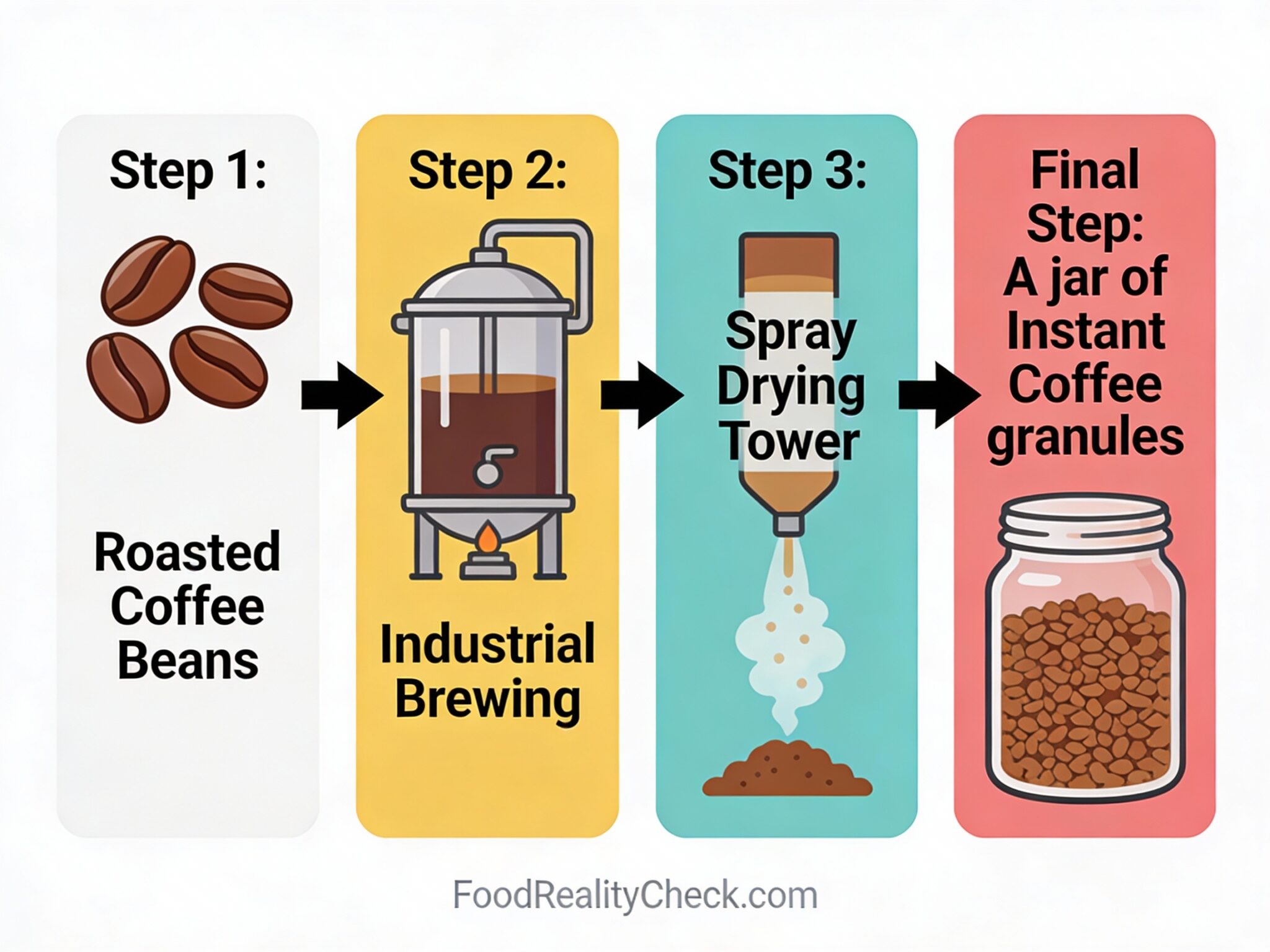
Instant coffee is made by brewing roasted, ground coffee, removing most of the water, and drying the coffee extract into small crystals or powder. When you add hot water at home, those dried coffee solids dissolve and return to a drinkable form.
In the United States, most instant coffee sold in grocery stores is made from Arabica coffee, Robusta coffee, or a blend of both. The key difference between brands is not the basic idea, but the coffee beans, roast, extraction method, drying process, and flavor compounds saved during production.

What Is Instant Coffee?
Instant coffee is dehydrated brewed coffee. Manufacturers first make coffee in much the same way you do at home, but on a large scale. They then remove the water while keeping the soluble coffee compounds behind.
Regular ground coffee still contains insoluble plant material. It must stay in a filter or brewing basket. Instant coffee contains coffee solids that dissolve in water, so it needs no filter or brewing equipment.
The main ingredients are usually:
- Roasted coffee beans
- Water
- Sometimes a small amount of anti-caking or flavoring material, depending on the product
Plain instant coffee does not need sugar, milk, or other additives to dissolve. Flavored coffee mixes and instant cappuccino products are different. They may contain sugar, milk powder, oils, or other ingredients.
The finished product may look like:
- Fine powder
- Small, dry crystals
- Larger porous granules
These forms are made using different drying and finishing methods.
How Is Instant Coffee Made?
Manufacturers make instant coffee through a series of controlled steps: roasting, grinding, brewing, concentrating, drying, and packaging.
1. Coffee beans are selected and roasted
The process begins with green coffee beans. Roasters heat the beans until they develop the color, smell, and taste associated with coffee.
Roasting causes several changes:
- Water leaves the beans.
- The beans expand and become brittle.
- New aroma and flavor compounds form.
- The beans darken as the roast progresses.
Instant coffee can be made from different bean types and roast levels. A darker roast may taste more smoky or bitter, while a lighter roast can keep more fruit-like or acidic notes. The final taste also depends on the blend and the factory’s extraction method.
2. The roasted beans are ground
After roasting, the beans are ground into coarse or medium-sized particles. The grind must be fine enough for efficient extraction but not so fine that it blocks industrial equipment.
Factories may use large roller mills or other commercial grinders. The goal is to create particles with a fairly even size. This helps water move through the coffee at a controlled rate.
3. The coffee is brewed in large extractors
The ground coffee is placed into industrial extraction vessels. Hot water passes through the coffee under controlled conditions.
This step is similar to brewing coffee at home, but the machines are much larger. They use carefully controlled:
- Water temperature
- Pressure
- Contact time
- Coffee-to-water ratio
- Flow rate
The water dissolves compounds from the coffee, including caffeine, acids, sugars, minerals, and flavor molecules. It also carries some fine particles into the liquid extract.
Manufacturers usually extract coffee in stages. Early extraction can bring out many desirable flavor compounds. Later extraction may produce more bitter or harsh flavors, so factories must balance yield with taste.
The result is a strong liquid called coffee extract.
4. The extract is filtered and concentrated
Fresh coffee extract contains a large amount of water. Removing all of that water at once would take too much energy and could damage the flavor.
Manufacturers first concentrate the extract. They may use evaporation, freezing, or a combination of methods.
Evaporation
In evaporation systems, some water is removed as vapor. The equipment often uses reduced pressure, which allows water to boil at a lower temperature.
Lower temperatures can help protect delicate coffee aromas. However, heat can still change the flavor if the process is not carefully controlled.
Freeze concentration
Freeze concentration removes water by freezing it into ice. The ice can then be separated from the stronger coffee liquid.
This method can reduce heat exposure, which may help preserve certain flavor compounds. It can also require more equipment and energy than some evaporation systems.
The concentrated extract is now ready for drying.
5. Aroma compounds are captured and returned
Coffee flavor comes from many volatile aroma compounds. These compounds can evaporate easily, especially during roasting, brewing, and drying.
To protect the coffee’s smell, some manufacturers collect aroma vapors during the process. They may later add those captured aromas back to the dried coffee.
This step matters because coffee aroma strongly affects how people experience flavor. A product can contain coffee solids but still taste flat if too many aroma compounds are lost.
Not every brand uses the same aroma recovery system. This is one reason two instant coffees made from similar beans can taste very different.
6. The coffee extract is dried
The concentrated coffee extract is turned into a dry product using one of two main methods: spray drying or freeze drying.
Spray-dried instant coffee
Spray drying is a common commercial method.
The concentrated coffee extract is sprayed into a tall chamber filled with hot air. The droplets are very small, so the water evaporates quickly. Dry coffee particles fall to the bottom of the chamber.
The air is hot, but the tiny droplets lose water rapidly. This helps the particles dry before they spend much time at high temperature.
Spray-dried instant coffee often has:
- A fine powder form
- A lower production cost
- Fast production
- A strong, straightforward coffee flavor
The powder may later be treated to make it easier to scoop, measure, and dissolve.
Freeze-dried instant coffee
Freeze drying uses a different approach.
First, the concentrated coffee extract is frozen. The frozen coffee is then broken into pieces and placed in a vacuum chamber. Under low pressure, the ice changes directly from a solid into vapor. This process is called sublimation.
Because the water leaves without first becoming liquid, the coffee can retain more of its original shape and some delicate aromas.
Freeze-dried coffee often has:
- Larger crystals
- A more porous structure
- A lighter appearance
- A higher production cost
- A flavor that some drinkers find closer to brewed coffee
Freeze drying does not guarantee that every product will taste better. Bean quality, extraction, aroma recovery, and storage also affect the result.
7. The dried coffee may be agglomerated
Fine instant coffee powder can be dusty and may not wet quickly. Some manufacturers combine small particles into larger granules in a step called agglomeration.
Water, steam, or controlled moisture helps the particles stick together. The granules are then dried again.
Agglomerated coffee can:
- Dissolve more evenly
- Produce less dust
- Be easier to spoon
- Look more like small coffee crystals
Agglomeration changes the shape and handling of the coffee. It does not mean that the coffee is made from a different kind of bean.
8. The coffee is packaged to limit moisture and oxygen
Instant coffee absorbs moisture from the air. Moisture can cause clumping and reduce quality.
Manufacturers package it in containers or sachets designed to limit exposure to:
- Humidity
- Oxygen
- Heat
- Light
A jar should be closed soon after use. Always use a dry spoon. If water enters the container, the coffee may form hard clumps.

Spray-Dried vs. Freeze-Dried Instant Coffee
The main difference is how the liquid coffee extract becomes dry.
| Feature | Spray-dried coffee | Freeze-dried coffee |
|---|---|---|
| Drying method | Fine droplets meet hot air | Frozen extract dries in a vacuum |
| Appearance | Fine powder or small particles | Larger crystals or porous pieces |
| Production cost | Often lower | Often higher |
| Aroma retention | Depends on heat control and aroma recovery | Often better at protecting delicate notes |
| Dissolving | Usually fast | Usually fast, but granule size varies |
| Taste | Can be bold and direct | May taste more rounded or closer to brewed coffee |
This table describes general process differences, not a universal quality ranking. A well-made spray-dried coffee can taste better than a poorly made freeze-dried product.
The best choice depends on what you value. Spray-dried coffee often suits people who want a low-cost, quick drink. Freeze-dried coffee may suit people who want larger crystals and a more complex flavor.
Why Does Instant Coffee Dissolve in Water?
Instant coffee dissolves because manufacturers remove water from a liquid coffee extract rather than simply grinding roasted beans into smaller pieces.
During brewing, water pulls soluble compounds from the roasted coffee. After drying, those compounds remain as solid coffee particles. Adding hot water allows the particles to dissolve again.
Not every part of a coffee bean dissolves. Cellulose and other plant materials remain largely insoluble. That is why regular ground coffee creates sediment or must be filtered, while instant coffee leaves little or no residue.
Hot water works faster because it moves through the coffee particles more easily. Instant coffee can dissolve in cold water, but it may take more stirring and may leave small lumps.
Is Instant Coffee Real Coffee?
Yes. Plain instant coffee is made from real roasted coffee beans and brewed coffee extract.
It is not the same as ground coffee because the manufacturing process changes some of its flavor and aroma. But it is still coffee, not merely a coffee-flavored powder.
The label can help you tell what you are buying. Look for:
- “Instant coffee”
- “Soluble coffee”
- A short ingredient list containing coffee
- “Decaffeinated” if most caffeine has been removed
A product labeled as a latte, mocha, coffee drink, or cappuccino mix may contain ingredients beyond coffee.
Does Instant Coffee Have Caffeine?
Most regular instant coffee contains caffeine. The exact amount depends on the serving size, brand, bean blend, and preparation.
A larger spoonful and a larger cup usually provide more caffeine than a small serving. Decaffeinated instant coffee still may contain a small amount of caffeine because decaffeination removes most, not necessarily all, of it.
If caffeine affects your sleep, heart rate, anxiety, or digestion, check the product label when available and consider the total caffeine in your day. The U.S. Food and Drug Administration says that up to 400 milligrams of caffeine per day is an amount not generally associated with dangerous negative effects for most healthy adults, but individual sensitivity varies. Pregnant people and anyone with a medical concern should ask a qualified health professional for personal guidance.
How Is Decaffeinated Instant Coffee Made?
Decaffeinated instant coffee starts with coffee beans that have had most of their caffeine removed before roasting.
Manufacturers commonly use water-based, carbon dioxide-based, or solvent-based decaffeination systems. Each method is designed to remove caffeine while keeping as much of the coffee’s flavor material as possible.
The decaffeinated beans are then:
- Roasted
- Ground
- Extracted with water
- Concentrated
- Spray dried or freeze dried
- Packaged
Decaffeination does not mean caffeine-free. In the United States, “decaffeinated” coffee can still contain a small amount of caffeine.
How Do You Make Instant Coffee at Home?
You cannot easily make true shelf-stable instant coffee at home without commercial drying equipment. A home freezer or oven will not reproduce industrial spray drying or vacuum freeze drying.
You can, however, make a strong coffee concentrate for short-term use:
- Brew coffee with less water than usual.
- Let it cool quickly.
- Store it in a clean, sealed container in the refrigerator.
- Use it within a short period and follow safe food-storage practices.
- Dilute it with hot or cold water when needed.
This is coffee concentrate, not instant coffee. It still contains water and can spoil. Do not leave it at room temperature for long periods, and do not assume that drying brewed coffee in an oven will make a safe or good instant product.

How to Prepare Instant Coffee for Better Flavor
Use the right amount of coffee and water first. A useful starting point is about 1 to 2 teaspoons of instant coffee per 8 fluid ounces of water, then adjust to taste. Product directions should take priority because crystal size and strength vary.
For a smoother cup:
- Use fresh, clean water.
- Heat the water until hot, but avoid repeatedly boiling it.
- Add a small amount of water first and stir the coffee into a paste.
- Add the rest of the water.
- Keep the jar tightly closed after use.
- Store it in a cool, dry place away from steam.
The small paste step helps wet the coffee evenly. It is most useful when the granules are large or the coffee tends to float.
Milk, cream, sugar, and spices can change the taste, but they cannot fix stale coffee or damp clumps. If the coffee smells flat, has absorbed odors, or tastes sharply stale, replacing it is usually more effective than adding more sweetener.
Common Problems With Instant Coffee
The coffee does not dissolve
Possible causes include:
- The water is too cold.
- The coffee has absorbed moisture.
- The product contains larger granules.
- Too much coffee was added at once.
Try adding a little hot water and stirring before filling the cup. If hard clumps remain, moisture may have damaged the product.
The coffee tastes bitter
Bitter flavor can come from the coffee blend, roast level, over-concentration, or very hot water. Use less coffee, more water, or a different product.
Adding sugar may reduce the perception of bitterness, but it does not remove bitter compounds.
The coffee tastes weak
Use more coffee or less water. Also check whether the spoon is smaller than the serving size listed on the label.
Weak flavor can result from a mild blend, stale storage, or a product designed for a larger cup than the one you are making.
The coffee smells stale
Oxygen, heat, moisture, and light can reduce coffee quality. Close the package after each use and keep it away from the stove, sink, and coffee maker steam.
If the product has an unusual odor, visible mold, or signs of contamination, do not drink it.
Key Takeaways
- Instant coffee is brewed coffee that has been dried.
- Roasted beans are ground, extracted with hot water, concentrated, and dried.
- Spray drying creates a powder by removing water from tiny droplets.
- Freeze drying freezes the extract and removes ice in a vacuum.
- Agglomeration combines fine particles into larger, easier-to-use granules.
- Instant coffee contains real coffee solids and usually contains caffeine unless labeled decaffeinated.
- Home-brewed concentrate is not the same as shelf-stable instant coffee.
- Dry storage and a tightly closed container help protect flavor.
Frequently Asked Questions
Is instant coffee made from leftover coffee?
Usually, no. Instant coffee is made from coffee beans that are intentionally roasted, ground, extracted, and dried. The final product is not simply old brewed coffee collected and dehydrated.
Is freeze-dried coffee healthier than spray-dried coffee?
There is no simple health advantage based only on the drying method. Both types are forms of instant coffee. The bigger differences may come from serving size, added sugar or cream, caffeine level, and the overall product formula.
Can instant coffee go bad?
Instant coffee has a long shelf life when kept dry and sealed. Its quality can decline before it becomes visibly spoiled. Discard it if it develops mold, an unusual smell, signs of moisture damage, or contamination.
Does instant coffee contain less caffeine than brewed coffee?
It may, but the answer depends on the serving size and preparation. A cup made with a small amount of instant coffee may contain less caffeine than a large cup of brewed coffee. Compare labels and serving sizes rather than relying on the preparation method alone.
Can I use instant coffee in baking?
Yes. Instant coffee can add coffee flavor to brownies, cakes, frosting, ice cream, and other foods. Dissolve it in a small amount of liquid first, or mix the powder into a dry ingredient when the recipe allows it.
Conclusion
Instant coffee is made by turning brewed coffee into a dry, soluble form. Manufacturers roast and grind coffee beans, extract them with water, concentrate the liquid, recover some aroma compounds, and dry the extract by spray drying or freeze drying.
For the best cup, choose a product whose roast and drying style match your taste, use the suggested serving size, and keep the coffee dry and sealed. If you need a quick coffee without brewing equipment, instant coffee works because the brewing step has already happened before the product reaches your kitchen.