
A backpack vacuum cleaner is a lightweight vacuum that you wear on your back while cleaning. In the United States, it is most useful for large homes, offices, schools, hotels, theaters, and other spaces where long floor-care sessions can strain the arms and shoulders. The best model depends on the floor type, cleaning area, dust needs, noise limits, cord access, and how often the machine will be used.
Compared with an upright vacuum, a backpack vacuum can make it easier to move around desks, chairs, stairs, doorways, and crowded rooms. However, it is not automatically better for every home. A good fit should feel balanced, provide enough airflow for the surface, use practical filters and bags, and meet the user’s safety and comfort needs.
What Is a Backpack Vacuum Cleaner?
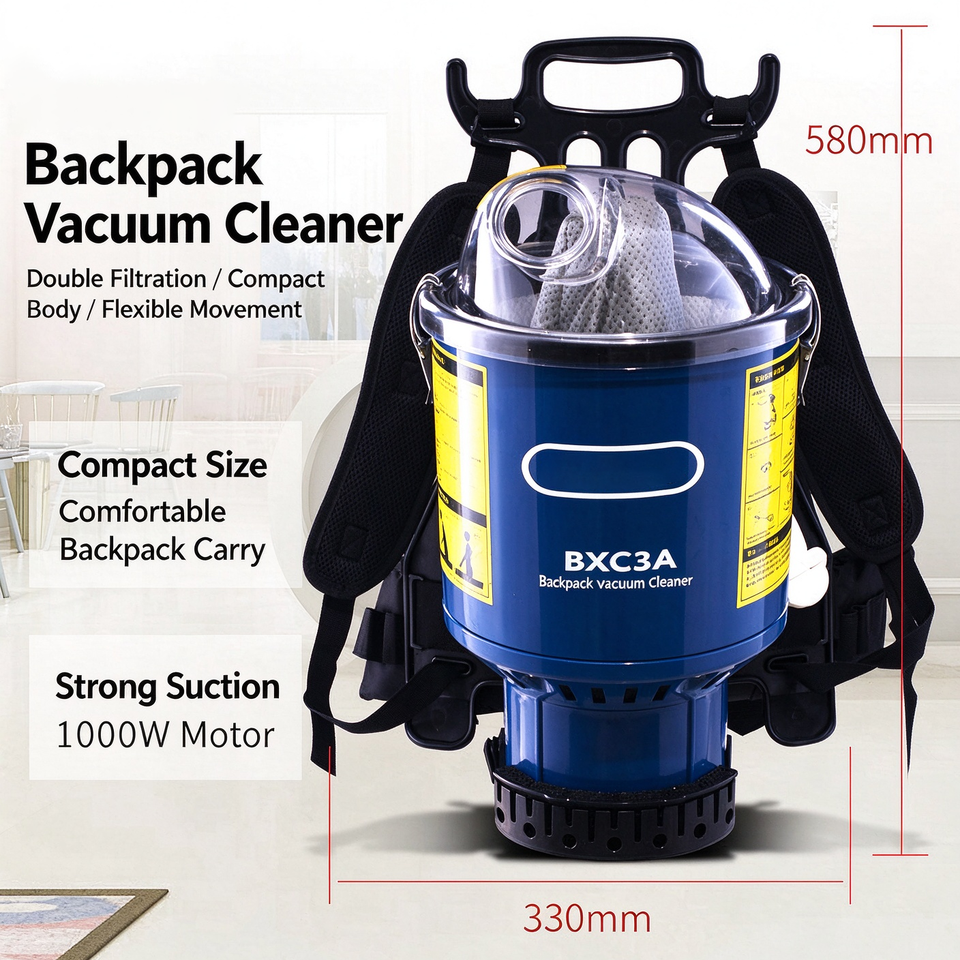
A backpack vacuum cleaner is a portable vacuum with shoulder straps, a waist belt, a flexible hose, and a cleaning wand. The motor and dust container sit behind the user, leaving both hands free to guide the hose and floor tool.
Most backpack vacuums are corded. Some commercial models use rechargeable batteries, but battery life, charging time, and replacement cost become part of the buying decision.
Main parts
A typical backpack vacuum includes:
- Motor: Creates suction and airflow.
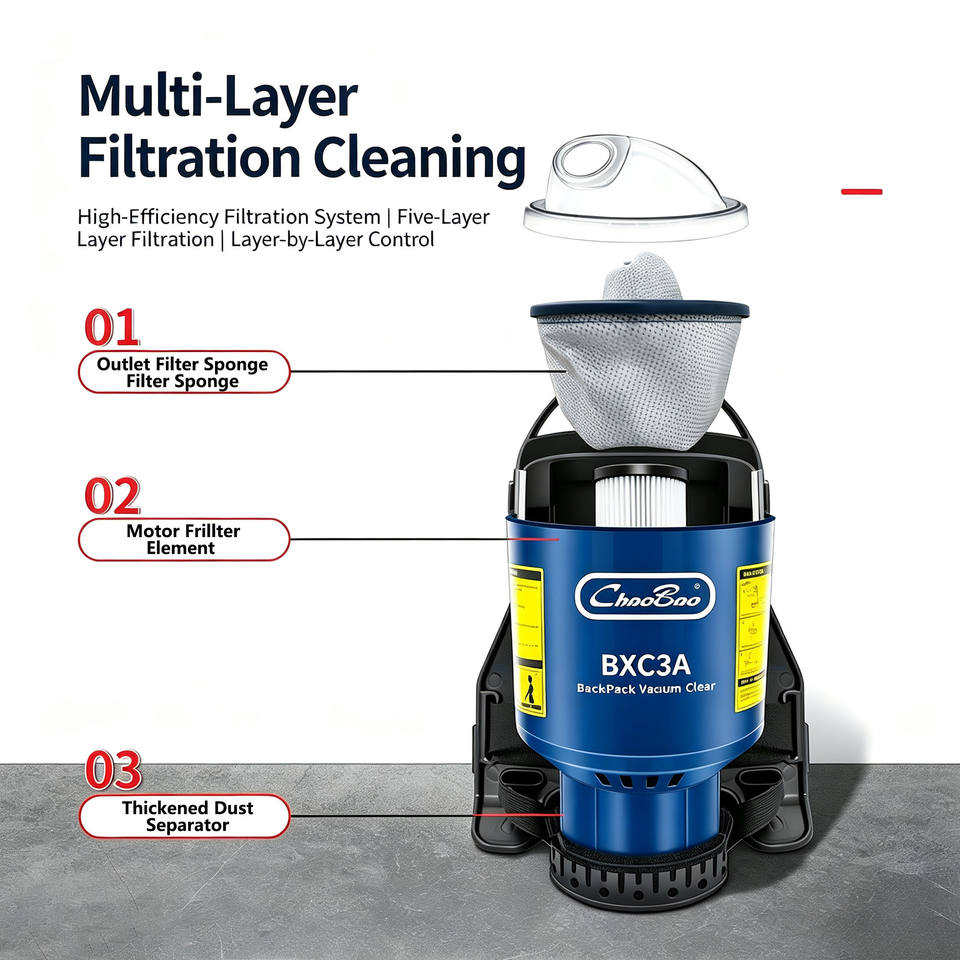
- Dust bag or dirt container: Collects dust and debris.
- Primary filter: Traps larger particles before they reach the motor.
- Secondary or exhaust filter: Cleans air leaving the machine.
- Hose: Connects the vacuum body to the wand.
- Wand and floor tool: Direct suction to carpet, tile, wood, or other surfaces.
- Harness: Spreads the load across the shoulders, chest, hips, or waist.
- Power cord or battery: Supplies energy to the motor.
The terms airflow, suction, and filtration describe different features. Airflow helps carry debris through the hose. Suction helps lift dirt from a surface. Filtration controls what happens to dust after it enters the machine. A vacuum needs a useful balance of all three.
Backpack vacuum vs. upright vacuum
An upright vacuum often works well for open carpeted areas. It may also include a powered brush roll that agitates carpet fibers. A backpack vacuum usually excels at movement and access rather than deep carpet agitation.
| Feature | Backpack vacuum | Upright vacuum |
|---|---|---|
| Mobility around furniture | Very good | Moderate |
| Open carpet cleaning | Good with the right tool | Often very good |
| Stairs | Convenient with a hose | Can be awkward |
| User contact with machine | Worn on the body | Pushed across the floor |
| Powered brush roll | Less common | Common |
| Storage | Compact body, separate tools | Larger upright form |
| Best use | Detailed or high-speed commercial cleaning | General home carpet cleaning |
A backpack vacuum can complement an upright vacuum rather than replace it. For example, a facility may use a backpack vacuum for daily detail work and a wider upright or walk-behind machine for large carpeted areas.

Who Should Use a Backpack Vacuum?
A backpack vacuum is a strong option when the user must cover many rooms, move around obstacles, or clean stairs and tight spaces. It can reduce the need to pull a canister behind the body or push a bulky vacuum around furniture.
Good uses
Backpack vacuums often suit:
- Commercial janitorial teams
- Schools and child-care facilities
- Offices with many desks and chairs
- Hotels and hospitality spaces
- Retail stores
- Movie theaters and performance venues
- Large homes with stairs
- Cleaning crews that need fast room-to-room movement
- Hard floors with dry dust and loose debris
A backpack model may be especially helpful in rooms with many obstacles. The user can walk forward while the hose reaches under desks, between chair legs, and along edges.
When another vacuum may be better
A backpack vacuum may not be the best choice when:
- The user has back, shoulder, neck, or balance problems
- The machine feels heavy after a short trial
- The main task is deep cleaning thick carpet
- The area has large amounts of wet material
- The user needs a powered floor brush
- The work site has strict noise limits
- A cord would create a trip hazard
- The operator cannot safely carry the machine
Never use a standard dry backpack vacuum to collect water or other liquids unless the manual clearly says it is designed for wet pickup. Water can damage electrical parts and may create a shock risk.
Comfort matters more than a small weight difference
A vacuum that weighs slightly more but has a well-designed harness may feel better than a lighter model with poor weight distribution. Look for adjustable shoulder straps, a stable waist belt, padded contact points, and controls that are easy to reach.
The user should be able to stand upright without leaning forward. If the hose pulls the body to one side, the tool may be too stiff, the harness may need adjustment, or the hose may be routed poorly.

How to Choose the Best Backpack Vacuum Cleaner
Choose a backpack vacuum by matching the machine to the building, floor, operator, and maintenance plan. Do not choose by motor wattage alone.
1. Match the vacuum to the floor
For smooth floors, choose a tool that does not scatter dust. A wide hard-floor head may improve coverage, while a narrow crevice tool helps with edges.
For carpet, check whether the vacuum includes a carpet tool or an air-powered brush. A simple suction head may remove loose debris but may not loosen embedded soil as well as a powered brush roll.
For mixed flooring, confirm that the included tools can switch between carpet and hard surfaces without scratching or leaving debris behind.
2. Check airflow and suction information
Manufacturers may list airflow in cubic feet per minute, suction in inches of water lift, or another measurement. These figures are useful only when tested under comparable conditions.
A high number in one test does not guarantee better cleaning in another machine. Hose design, floor tool width, filters, bag fullness, and airflow restrictions all affect real performance.
Treat the published figures as one part of the decision. A practical test on the actual floor is more useful when available.
3. Choose the right filtration
A backpack vacuum may use a standard filter, a high-efficiency filter, or a HEPA filter. HEPA is a filtration classification, not a promise that the entire vacuum system is sealed.
Ask these questions:
- Does the model use a genuine HEPA filter?
- Is the filter part of a sealed system?
- Does the manufacturer state the test method?
- Are replacement filters easy to find?
- Does the bag capture fine dust before it reaches the filter?
- Can the filter be cleaned, or must it be replaced?
For ordinary dust, a good bag and maintained filter may be enough. For fine construction dust, mold cleanup, lead, asbestos, or other hazardous materials, use a vacuum and procedure specifically approved for that material. A general commercial vacuum is not automatically safe for hazardous dust.
The U.S. Environmental Protection Agency explains that portable air cleaners and vacuum systems differ in design and purpose. Filtration claims should be read with the full system, maintenance needs, and use case in mind. See the EPA guide to air cleaners and air filters.
4. Compare corded and cordless models
Corded backpack vacuums can run as long as the user has safe access to a suitable outlet. They often work well for long cleaning shifts.
Cordless models reduce cord hazards and can move quickly between rooms. Their limits include:
- Run time changes with power level and tool choice
- Batteries wear out over time
- Charging may interrupt a work shift
- Replacement batteries can be costly
- The battery adds weight
For commercial work, calculate whether the battery can cover the planned area without unsafe rushing or frequent swaps.
5. Consider noise
A backpack vacuum near the user’s ears can seem louder than a floor-based vacuum, even if published sound ratings appear similar. Noise can affect comfort, communication, and hearing safety.
Ask for the manufacturer’s sound rating and test condition. If workers use the machine for long periods, review the employer’s hearing-conservation practices. OSHA provides information on occupational noise exposure and hearing protection through its occupational noise exposure standard.
Do not assume that a quiet setting always cleans as well. Some models reduce power when switched to a lower-noise mode.
6. Check bags, filters, tools, and repairs
A vacuum is easier to own when its consumable parts remain available. Before buying, check:
- Dust bag type and capacity
- Bag price and local availability
- Replacement filter cost
- Hose and wand availability
- Battery replacement cost, if applicable
- Warranty length and coverage
- Authorized service options
- Tool compatibility
A low purchase price can become expensive if bags are hard to find or the hose is not replaceable.
How to Use a Backpack Vacuum Correctly
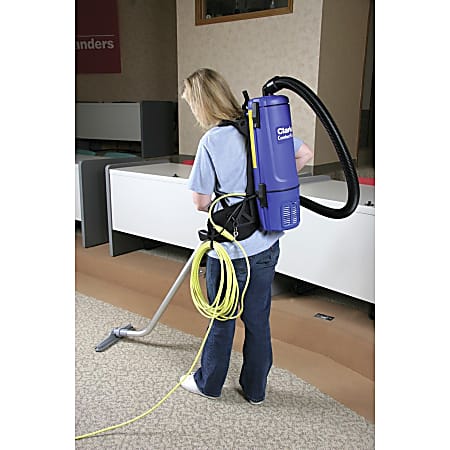
Correct setup improves comfort, cleaning results, and safety. Read the model’s manual before the first use because harness controls and filter systems vary.
Before cleaning
- Inspect the vacuum. Check the cord, plug, hose, wand, floor tool, bag, and filters.
- Install the correct bag. A missing or poorly fitted bag can send dust into the motor or back into the room.
- Adjust the harness. Loosen the straps before putting on the machine.
- Lift safely. Use a stable surface or ask for help with a heavy unit.
- Secure the shoulder straps. Keep the vacuum centered on the back.
- Fasten the waist belt. It should carry part of the load without cutting into the body.
- Adjust the chest strap if included. It can reduce strap movement.
- Route the hose. Keep it near the side that gives the best control.
- Plug into a safe outlet. Use the correct voltage and avoid damaged extension cords.
The harness should feel firm but not restrictive. The user should be able to breathe, turn, bend slightly, and walk without the vacuum shifting.
Cleaning sequence
Use a consistent path:
- Remove large objects by hand.
- Start at the far end of the room.
- Clean edges and corners first.
- Move across the open floor in overlapping passes.
- Use the correct tool for the surface.
- Clean under furniture when the tool can reach without forcing the body into an unsafe position.
- Watch the cord or battery level.
- Empty or replace the bag before airflow drops sharply.
Do not swing the floor tool rapidly. Slow, even passes usually give the tool more time to lift soil.
Signs of correct operation
The vacuum is likely working as intended when:
- Airflow remains steady
- The tool stays close to the floor without excessive force
- The motor does not smell hot
- The bag fills evenly
- Dust does not escape from seams or exhaust
- The harness remains stable
- The user can maintain an upright posture
Stop using the vacuum if it produces smoke, sparks, a burning smell, unusual vibration, or a sudden loss of power. Unplug a corded model before inspecting it.

Backpack Vacuum Maintenance
Regular maintenance protects suction and extends the useful life of the machine. The most common cause of poor performance is a full bag, blocked hose, or dirty filter.
After each use
- Turn off and unplug the vacuum before service.
- Remove the machine carefully.
- Empty or replace the bag according to the manual.
- Inspect the hose for clogs.
- Check the floor tool for hair, thread, and debris.
- Wipe the outside with a suitable dry or slightly damp cloth.
- Store the cord without tight kinks.
- Place the vacuum in a dry area.
Do not shake dusty filters indoors. Fine dust can return to the air and settle on nearby surfaces.
When suction drops
Check the problem in this order:
- Confirm that the vacuum is receiving power.
- Check whether the bag is full or installed incorrectly.
- Inspect the floor tool.
- Look through the hose for a blockage.
- Check the wand.
- Inspect the primary filter.
- Inspect the exhaust filter.
- Look for cracks, loose seals, or a damaged hose.
If the motor becomes louder while airflow falls, a blockage or restricted filter is likely. If the motor runs but the tool has little suction, inspect the bag, hose, seals, and floor head.
Filter replacement
Follow the manual for cleaning and replacement intervals. Some filters can be washed; others must stay dry. Washing a filter that is not designed for water can damage it and reduce filtration.
Never operate the vacuum without required filters. A missing filter can allow dust to reach the motor and may send fine particles into the room.

Backpack Vacuum Safety in the United States
Use a backpack vacuum only for materials and conditions listed in its manual. A dry vacuum is not a substitute for a certified system used for hazardous dust.
Electrical safety
The Occupational Safety and Health Administration recommends safe practices for electrical equipment and cords in workplaces. Before use:
- Do not use a cut, crushed, or hot power cord.
- Keep plugs and connections away from water.
- Do not pull the vacuum by its cord.
- Unplug by holding the plug, not the cable.
- Use grounded equipment as required.
- Avoid running cords across walkways.
- Use a cord-management plan in public areas.
The OSHA electrical safety resource provides workplace guidance. Employers should also follow site rules and applicable local requirements.
Dust and hazardous materials
Do not collect asbestos, lead dust, silica dust, mold-contaminated material, flammable dust, or chemical powder with a general backpack vacuum unless the equipment and work procedure are specifically approved for that hazard.
Fine particles can pass through unsuitable filters or contaminate the machine. Some dusts also create fire or explosion risks. For hazardous material, consult the applicable safety data sheet, workplace safety plan, and a qualified industrial hygiene or safety professional.
Ergonomic safety
Rotate tasks when possible, especially during long shifts. Take short breaks, keep the load balanced, and report pain early.
A backpack vacuum should not cause numbness, sharp pain, breathing difficulty, or loss of balance. If the harness cannot be adjusted to fit the operator, stop using that machine.

Backpack Vacuum Cleaner Cost: A Simple Ownership Estimate
The purchase price is only one part of backpack vacuum cost. A useful estimate includes consumables, labor, repairs, batteries, and replacement tools.
Use this basic formula:
Estimated annual cost = purchase price ÷ expected service years + bags + filters + repairs + battery costs
Hypothetical example
Suppose a commercial user buys a vacuum for $600 and expects to use it for five years:
- Equipment allocation: $600 ÷ 5 = $120 per year
- Bags: $12 per month × 12 = $144 per year
- Filters and minor parts: $60 per year
- Repairs: $75 per year
Estimated annual ownership cost: $399
This is only a planning example. Actual costs depend on the model, work hours, dust load, bag capacity, maintenance quality, and local prices.
For a business, also consider labor time. A vacuum that reaches desks and corners without moving furniture may reduce cleaning time, but that benefit must be measured at the site rather than assumed from marketing claims.

Common Backpack Vacuum Mistakes
Avoiding a few simple mistakes can prevent poor cleaning and early failure.
Choosing by motor power alone
Motor wattage does not describe the complete cleaning system. Airflow, filtration, seals, tools, and hose design also affect results.
Ignoring the harness
A poorly fitted harness can turn a useful machine into a daily strain. Test the fit with the hose attached and the bag installed.
Using the wrong floor tool
A hard-floor head may not deep-clean carpet. A carpet tool may scatter loose debris on smooth floors. Match the tool to the surface.
Waiting too long to replace the bag
A full bag can reduce airflow and increase motor load. Replace it before it becomes packed or difficult to remove.
Cleaning wet spills with a dry model
This can damage the motor and create an electrical hazard. Use an approved wet/dry machine when liquid pickup is required.
Treating “HEPA” as a complete safety claim
A HEPA filter does not make every vacuum suitable for hazardous dust. The bag system, seals, filter fit, disposal process, and certification all matter.
Frequently Asked Questions
Are backpack vacuums better than upright vacuums?
Neither type is best for every task. Backpack vacuums are often better for mobility, stairs, edges, and crowded rooms. Upright vacuums may be better for large carpet areas and models with powered brush rolls.
Can a backpack vacuum clean hardwood floors?
Yes, if it includes a suitable hard-floor tool. Use the manufacturer’s recommended attachment and check that the tool does not drag grit or scratch the finish.
Are backpack vacuums good for home use?
They can work well in large homes, homes with stairs, and spaces with many obstacles. For a small home with limited floor area, a compact canister, stick, or upright vacuum may be simpler.
How long does a backpack vacuum last?
Service life varies with construction, use frequency, dust load, maintenance, and access to replacement parts. Regular bag and filter care can help, but no fixed lifespan applies to every model.
Can children use a backpack vacuum?
Children should not operate commercial cleaning equipment unless the equipment, supervision, training, and local rules clearly allow it. The machine must also fit the operator safely.
Conclusion
A backpack vacuum cleaner is most valuable when mobility and access matter. It can make large or crowded spaces easier to clean, but it should not be selected by suction claims or price alone.
Before buying, compare the floor tools, harness, filtration, noise, cord or battery system, replacement parts, warranty, and service support. Then test the machine on the actual floor if possible. The right model is the one that cleans effectively, fits the operator, and remains practical to maintain over time.


One Comment