
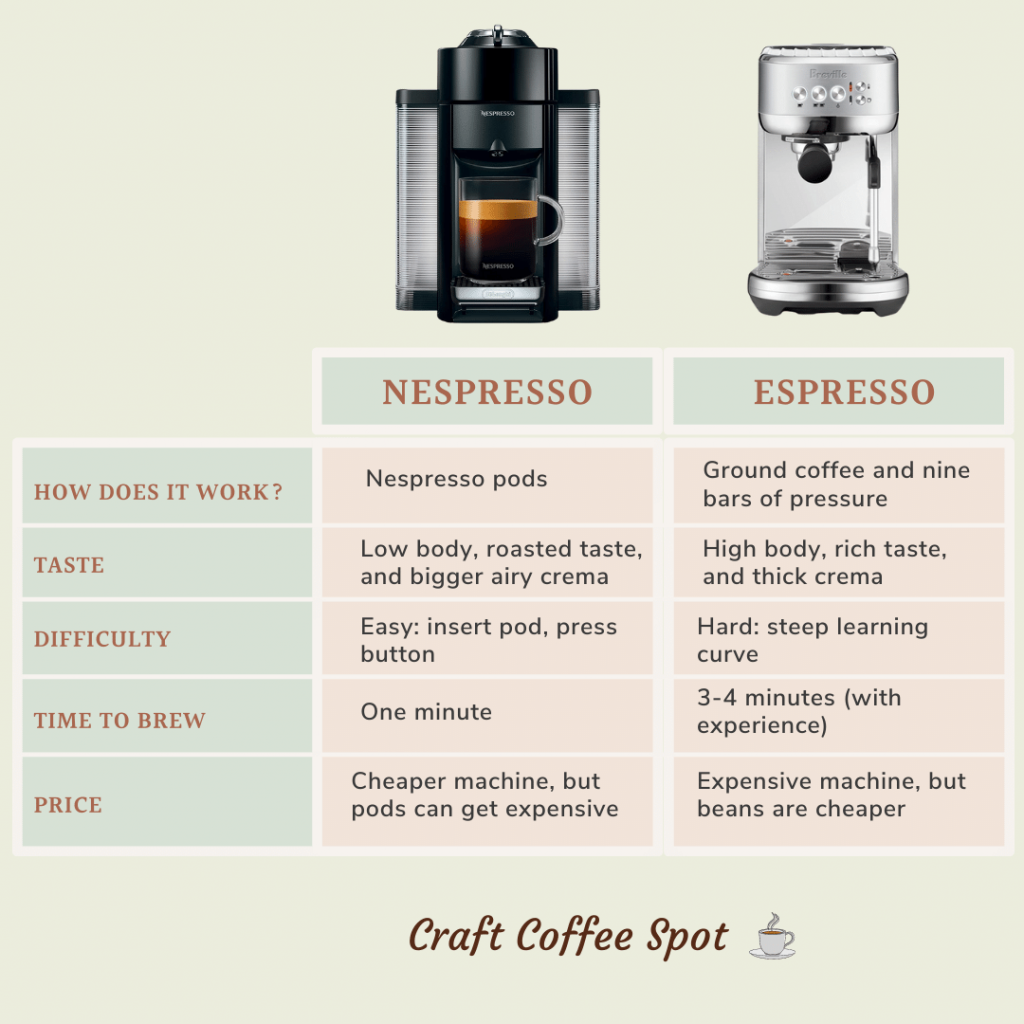
For most people in the United States, Nespresso is better for speed and ease, while a traditional espresso machine is better for control, fresh coffee, and café-style drinks. Nespresso uses premeasured capsules. An espresso machine uses ground coffee and gives you control over the dose, grind, tamp, and extraction.
Choose Nespresso if you want a fast, clean cup with little practice. Choose an espresso machine if you enjoy learning the process, want richer control over flavor, or plan to make espresso drinks often.
The best choice depends on four things: your budget, how much effort you want to spend, the drinks you make, and the long-term cost of capsules or coffee beans.

Nespresso vs. Espresso Machine: The Main Differences
Nespresso is a capsule-based coffee system. A Nespresso machine pierces a sealed capsule, pushes hot water through it, and pours the drink into your cup. The process is mostly automatic.
A traditional espresso machine uses loose coffee grounds. You usually need to grind the beans, measure the dose, distribute the grounds, tamp them, lock in the portafilter, and stop the shot at the right time.
| Feature | Nespresso | Traditional espresso machine |
|---|---|---|
| Ease of use | Very easy | Requires practice |
| Brewing time | Often about 1–2 minutes, including setup | Often 5–15 minutes with grinding and cleanup |
| Coffee format | Premeasured capsule | Loose ground coffee |
| Control | Limited | High |
| Flavor adjustment | Mostly through capsule choice | Through grind, dose, tamp, temperature, and time |
| Milk drinks | Easy with a separate frother or built-in system | Steam wand offers more control |
| Cleanup | Low | Moderate to high |
| Cost per drink | Usually higher than beans | Often lower after buying equipment |
| Drink size | Depends on the Nespresso line and capsule | Controlled by the user |
| Best for | Convenience and repeatability | Freshness, skill, and customization |
The biggest difference is not pump pressure. It is control. Nespresso removes many choices to make brewing simple. An espresso machine gives you those choices back.
How Nespresso Works
Nespresso machines brew coffee from single-use capsules. The capsule contains preground coffee sealed for storage. When you insert it, the machine reads or uses the capsule design, heats water, and forces water through the coffee.
Nespresso sells two main capsule systems in the United States:
- OriginalLine: Uses smaller, dome-shaped capsules. It focuses on espresso and lungo drinks.
- Vertuo: Uses larger capsules in several sizes. The machine reads a barcode on the capsule and adjusts the brewing process.
OriginalLine and Vertuo capsules are not interchangeable. A buyer should choose the system before purchasing a machine because the capsule system affects future coffee choices.
OriginalLine
OriginalLine machines are closer to the classic espresso format. They commonly brew:
- Espresso, about 1.35 fluid ounces
- Lungo, about 3.7 fluid ounces
Exact drink options vary by model. OriginalLine machines use pressure-based extraction and are often compatible with third-party capsules, although compatibility, quality, and warranty terms can vary.
Vertuo
Vertuo machines offer more drink sizes. Depending on the model and capsule, they may brew espresso, double espresso, gran lungo, mug, or larger coffee servings.
Vertuo machines use a barcode system to identify the capsule. This lets the machine set the water volume and brewing pattern automatically. Vertuo is often more useful for people who want both small espresso drinks and larger cups of coffee.
That convenience also creates a trade-off: Vertuo users are more dependent on Nespresso’s capsule range and system.

How a Traditional Espresso Machine Works
A traditional espresso machine pushes hot water through a compact bed of ground coffee. The goal is to extract flavor under controlled conditions and produce a concentrated drink with crema, the tan foam that forms on top of a fresh espresso shot.
A basic workflow looks like this:
- Grind coffee beans.
- Measure the grounds into a portafilter.
- Distribute the grounds evenly.
- Tamp the coffee with steady pressure.
- Lock in the portafilter.
- Start the shot.
- Stop the shot based on time, weight, or taste.
- Knock out the used grounds and rinse the equipment.
The machine is only one part of the system. The grinder matters greatly. A low-quality or inconsistent grinder can make a good espresso machine difficult to use.
Many home espresso users begin with a double shot of about 18–20 grams of coffee and adjust from there. However, the correct dose depends on the basket, machine, coffee, and recipe. There is no single dose that works for every setup.
Pump pressure is not the whole story
Home espresso machines often advertise a pump rating of 15 or 19 bar. Espresso is generally brewed at a lower pressure at the coffee puck, commonly near 9 bar in traditional recipes.
A higher advertised pump number does not automatically mean better coffee. Pressure stability, water temperature, grind size, coffee freshness, and puck preparation also affect the result.
This is one reason a capsule machine and a traditional espresso machine should not be compared by pressure alone.

Coffee Quality and Flavor
A traditional espresso machine usually offers the higher flavor ceiling. You can select fresh beans, change the grind, adjust the dose, and control the extraction. These changes can reveal fruit, chocolate, nut, spice, or caramel notes.
Nespresso offers more consistency with less work. Each capsule contains a fixed coffee blend and dose. If you like a capsule, you can repeat the same drink without weighing beans or adjusting a grinder.
The flavor difference depends on the capsule, coffee freshness, machine, and recipe. A well-made Nespresso drink can be enjoyable, while a poorly prepared espresso shot can taste sour, bitter, or thin.
Nespresso may be better when consistency matters
Nespresso is a strong fit for:
- Busy mornings
- Shared kitchens
- Offices
- People who do not want to learn espresso technique
- Households with different coffee preferences
- Users who want little mess
An espresso machine may be better when taste control matters
A traditional machine is a stronger fit for:
- Freshly roasted coffee
- Single-origin beans
- Dialing in different recipes
- Making café-style drinks
- Learning coffee skills
- Reducing the cost per drink over time
Neither system guarantees better coffee. The machine removes or adds variables. Your preferred balance between convenience and control is the deciding factor.

Which Makes Better Lattes and Cappuccinos?
Both systems can make good milk drinks, but a traditional espresso machine gives you more control over the milk.
A Nespresso machine makes the coffee base with one button. You can then add steamed or frothed milk using a separate frother, a built-in milk unit, or a manual method. This is fast and simple, but the milk texture may be less flexible.
A traditional espresso machine with a steam wand lets you control:
- Milk temperature
- Foam amount
- Foam texture
- Pour speed
- Microfoam quality
Microfoam is the smooth, fine-textured milk used for many café drinks and latte art. Creating it takes practice. A steam wand can also heat milk too much, which may damage texture and produce a flat taste.
For a beginner who wants a quick latte, Nespresso is easier. For someone who wants to practice café technique, an espresso machine is more capable.

Cost Comparison: Nespresso Capsules vs. Coffee Beans
Nespresso often costs less at the time of purchase but more per drink. A traditional espresso setup usually costs more at the start because you may need a machine, grinder, scale, tamper, and other tools.
Use this formula to compare long-term cost:
Annual coffee cost = drinks per year × cost per drink
Hypothetical example
Assume a person makes two drinks each day for one year:
- 2 drinks per day × 365 days = 730 drinks
- Capsule cost: $0.80 per drink
- Coffee bean cost: $0.25 per drink
The annual coffee cost would be:
- Capsules: 730 × $0.80 = $584
- Beans: 730 × $0.25 = $182.50
The difference is $401.50 per year, before counting equipment, milk, electricity, cleaning products, shipping, or wasted coffee.
This is only an example. Actual prices change by brand, roast, capsule type, dose, sales, and location in the United States. A larger capsule or double espresso may cost more than a small capsule. Some espresso users also waste beans while learning.
Break-even calculation
To estimate when a traditional setup may recover its higher initial cost, use:
Break-even drinks = extra equipment cost ÷ savings per drink
For example, if an espresso setup costs $400 more than a Nespresso setup and saves $0.50 per drink:
$400 ÷ $0.50 = 800 drinks
At two drinks per day, 800 drinks would take about 13 months. This is a planning example, not a guarantee.

Maintenance and Daily Cleanup
Nespresso usually requires less daily maintenance. After brewing, you may need to eject the capsule, empty the used-capsule container, and wipe or rinse parts that contact coffee or milk.
You should still follow the manual for:
- Water tank cleaning
- Capsule container cleaning
- Rinsing cycles
- Descaling
- Milk-system cleaning
- Storage and filter replacement, if included
A traditional espresso machine needs more hands-on care. After each shot, you should generally:
- Knock out the coffee puck.
- Rinse the portafilter.
- Flush the group head.
- Wipe the steam wand after steaming milk.
- Purge the steam wand briefly according to the manual.
Regular deeper maintenance may include backflushing, cleaning the shower screen, washing baskets, and descaling when needed.
Hard water can cause scale buildup in both types of machines. The correct descaling schedule depends on water hardness, machine design, and the manufacturer’s instructions. Do not use vinegar unless the machine maker specifically permits it. Some manufacturers warn that vinegar can damage parts or leave an odor.

Capsules, Freshness, and Environmental Trade-Offs
Capsules reduce mess and help protect coffee from air before use. They also create more packaging waste than buying coffee in a larger bag, although the full environmental impact depends on materials, transport, energy, recycling, and how much coffee is wasted.
Nespresso has recycling programs in some markets, including the United States. Program details, collection options, and accepted materials can change. Check the current Nespresso recycling information for your location before assuming a capsule can go in household recycling.
Traditional espresso creates used coffee grounds rather than a single capsule. Grounds can often go into compost or household waste, depending on local rules. However, coffee bags, shipping materials, and wasted beans still have an environmental cost.
The most practical approach is to:
- Use the amount of coffee you need.
- Avoid buying equipment you will not use.
- Recycle capsules through an accepted program.
- Reuse or compost grounds where local rules allow.
- Keep the machine in service through proper cleaning and repair.
No system is impact-free. The better choice depends on your use pattern and local recycling options.

Which System Is Easier for Beginners?
Nespresso is easier for a first-time user. You do not need to learn grind size, tamping, shot timing, or milk steaming. The main skill is choosing a capsule and keeping the machine clean.
A traditional espresso machine has a learning curve. Common beginner problems include:
- A sour shot from a grind that is too coarse or an extraction that is too short
- A bitter shot from a grind that is too fine or an extraction that is too long
- Channeling from uneven grounds
- Weak coffee from too little coffee or poor puck preparation
- Slow shots from an overly fine grind
- Poor milk texture from overheating or adding too much air
A good grinder and a simple recipe can make the learning process easier. New users should change one variable at a time. Adjusting grind, dose, temperature, and timing all at once makes it hard to learn what helped.
If you want coffee with no training, choose Nespresso. If you see brewing as a hobby, an espresso machine may be more rewarding.

Nespresso vs. Espresso Machine: Pros and Cons
Nespresso advantages
- Fast brewing
- Very little mess
- Consistent portions
- Simple operation
- No grinder required
- Easy to use in a shared space
- Good for people who drink different capsule styles
Nespresso limitations
- Higher cost per drink in many cases
- Less control over extraction
- Dependence on a capsule system
- Capsule waste
- Limited ability to use freshly ground coffee
- Some models produce coffee that is less like traditional espresso
Traditional espresso machine advantages
- More control over flavor
- Freshly ground coffee
- Lower cost per drink after setup
- Better control over milk texture
- Freedom to choose beans and recipes
- Useful for espresso-based drink practice
Traditional espresso machine limitations
- Higher starting cost
- More cleanup
- A grinder is often essential
- Results can vary while you learn
- More counter space may be needed
- Equipment may need repair or replacement
The practical choice is simple: Nespresso trades control for convenience, while an espresso machine trades convenience for control.

Decision Guide: Which One Should You Buy?
Choose Nespresso if:
- You want coffee ready with one button.
- You dislike grinding and tamping.
- You make coffee in a shared office or kitchen.
- You prefer low daily cleanup.
- You want both espresso-sized drinks and larger cups, especially with Vertuo.
- You value repeatable results more than recipe control.
Choose a traditional espresso machine if:
- You want to use fresh beans.
- You enjoy learning a coffee skill.
- You want to adjust flavor precisely.
- You make several espresso drinks every day.
- You care about textured milk and latte art.
- You want more freedom to choose coffee roasters.
Consider a semi-automatic espresso machine with a good grinder if you want a middle path. It requires work but gives more control than Nespresso. A super-automatic machine may fit users who want fresh beans with more automation, although it still costs more and requires cleaning.
Before buying, check the counter space, water tank size, warranty, repair options, capsule or bean cost, and the drinks you actually plan to make.

Common Buying Mistakes
The most common mistake is buying a machine based only on its advertised pressure. Pressure does not tell you how easy the machine is to use or how good every drink will taste.
Other mistakes include:
- Buying a Vertuo machine while wanting third-party capsules
- Forgetting that OriginalLine and Vertuo capsules differ
- Buying an espresso machine without budgeting for a grinder
- Choosing a milk system that is difficult to clean
- Ignoring the cost of capsules over several years
- Treating crema as proof of quality
- Using the wrong basket or grind size
- Skipping descaling and cleaning
- Assuming every capsule is recyclable through curbside pickup
- Buying a large machine without checking counter depth and cabinet clearance
A simple checklist can prevent most problems: decide your drink size, daily volume, coffee source, cleanup tolerance, and long-term budget before choosing the machine.
Frequently Asked Questions
Is Nespresso real espresso?
Nespresso makes concentrated coffee drinks that can resemble espresso. OriginalLine drinks are designed around espresso and lungo sizes. Vertuo drinks use a different brewing system and offer several larger sizes. Whether the result meets your personal definition of traditional espresso depends on the system and drink.
Is Nespresso cheaper than an espresso machine?
Nespresso is often cheaper to buy at first, but capsules can cost more per serving than coffee beans. A traditional setup may become less expensive per drink after the equipment cost is recovered. Compare your expected drink volume, capsule price, bean price, and equipment cost.
Does Nespresso taste better than a regular coffee maker?
Nespresso usually produces a more concentrated drink than a standard drip coffee maker. “Better” depends on taste. A drip brewer may be better for a full mug, while Nespresso is better for quick concentrated coffee. A traditional espresso machine offers the most control.
Can you use regular coffee in a Nespresso machine?
Most Nespresso machines are designed for their specific capsule systems. You should not put loose coffee directly into the machine. Reusable or refillable capsules may work with some models, but performance, safety, and warranty effects vary. Follow the machine maker’s instructions.
How long does a Nespresso machine last?
Service life depends on the model, water quality, cleaning, use, and repairs. Regular rinsing and proper descaling can help reduce buildup. Check the warranty and repair policy before buying because support differs by model and region.
Do espresso machines need a grinder?
Most traditional espresso machines work best with freshly ground coffee, so a grinder is strongly recommended. Pre-ground coffee can work in some setups, but it gives you less control over freshness and grind size.
Key Takeaways
- Nespresso is best for speed, low effort, and consistent results.
- A traditional espresso machine is best for fresh coffee, control, and milk texture.
- OriginalLine and Vertuo are different Nespresso systems.
- Capsule drinks often cost more per serving than coffee made from beans.
- A traditional setup usually needs a capable grinder.
- Cleaning and descaling matter for both systems.
- Compare your daily drink count and long-term cost, not just the purchase price.
Conclusion
Nespresso and traditional espresso machines serve different needs. Nespresso makes coffee simple by controlling most of the brewing process for you. A traditional espresso machine takes more time and practice but gives you far more control over taste and milk drinks.
For a busy American household that wants fast coffee with little cleanup, Nespresso is often the more practical choice. For a coffee enthusiast who wants fresh beans, café-style technique, and lower drink costs over time, a traditional espresso machine is usually the better fit.
Your next step is to write down the drinks you make in a normal week, then compare the machine cost, capsule or bean cost, counter space, and cleanup time for each system.


One Comment