An espresso machine makes coffee by pushing hot water through finely ground coffee at high pressure. In a U.S. home machine or coffee shop, the process uses a water tank or plumbing line, a heater, a pump, a group head, and a portafilter. Together, these parts control heat, pressure, flow, and time.
The goal is a small, strong coffee with a rich flavor and a layer of foam-like crema on top. Each part of the machine affects the final drink, so learning how the system works can help you brew better espresso and fix common problems.
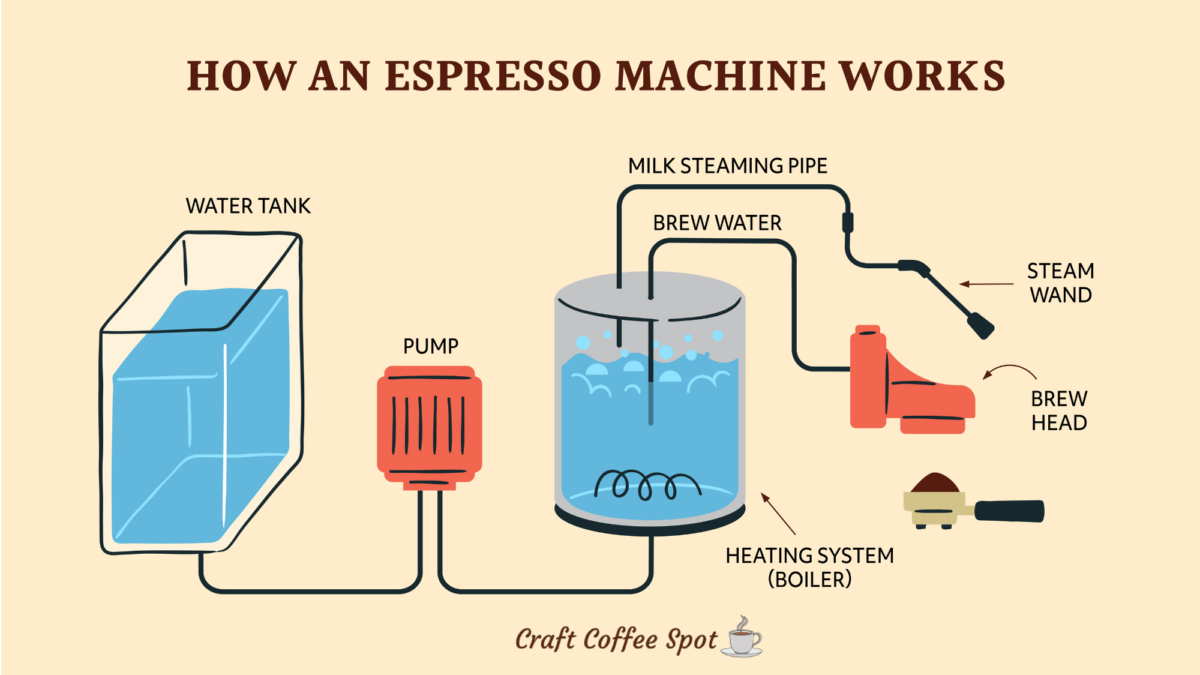
The Basic Espresso-Making Process
An espresso machine follows a simple path: water enters, heat raises its temperature, a pump creates pressure, and the water moves through a compact coffee puck.
Here is the process in order:
- You fill the water tank or connect the machine to a water line.
- The machine heats the water.
- You grind coffee and press it into the portafilter.
- You lock the portafilter into the group head.
- The pump pushes water toward the coffee.
- The group head spreads water across the coffee puck.
- Water extracts flavor as it passes through the grounds.
- Espresso flows into the cup.
The machine does not simply “force water through coffee.” It must keep several conditions within a useful range. Water that is too cool may produce sour espresso. Water that is too hot may create bitter or burnt flavors. Poorly ground coffee can cause the water to flow too fast or too slowly.
A typical espresso recipe may use about 18 grams of ground coffee to produce about 36 grams of liquid espresso. That is a 1:2 ratio by weight. This is a common starting point, not a rule for every coffee or machine.

What Are the Main Parts of an Espresso Machine?
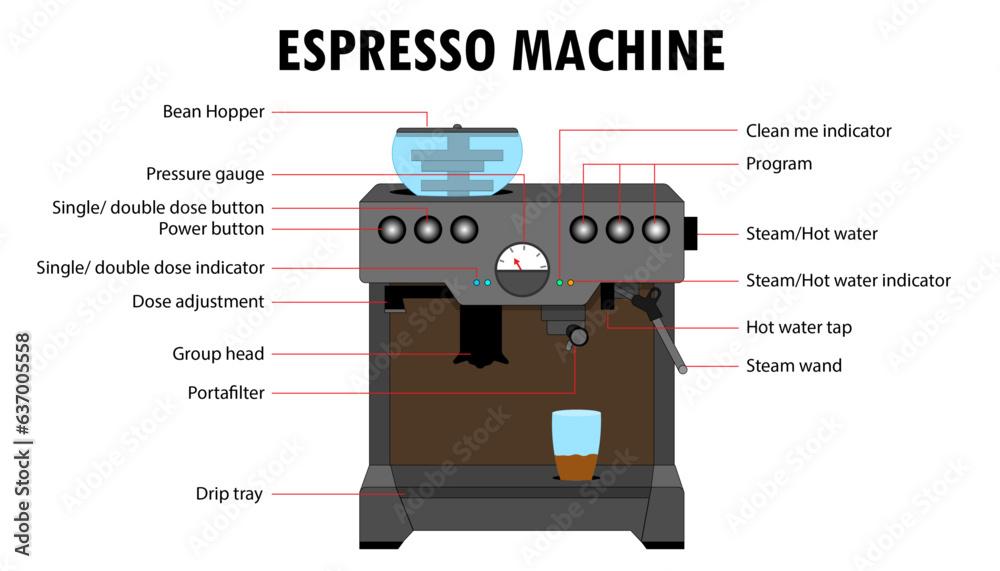
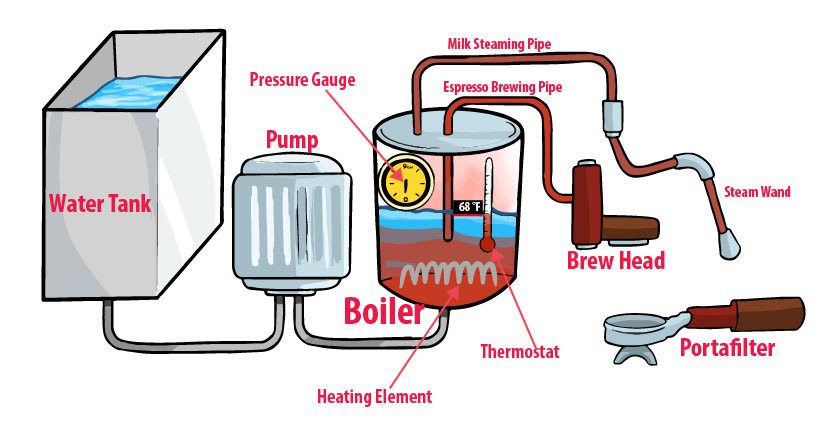
The main parts of an espresso machine are the water system, heating system, pump, group head, portafilter, and steam system. Each part performs a different job.
Water tank or water line
Most home espresso machines use a removable water tank. Larger commercial machines often connect to a plumbing line.
The water source feeds the machine’s heating system. Clean, low-scale water helps protect the machine and reduces unwanted flavors. Hard water can leave mineral deposits inside the boiler, valves, and passages.
Use the water type listed in your machine’s manual. A water filter may help, but not every filter is suitable for every machine.
Pump
The pump moves water through the brewing system. Many modern machines use a vibration pump or a rotary pump.
- Vibration pumps are common in home machines. They make a noticeable buzzing sound and build pressure when brewing begins.
- Rotary pumps are common in commercial machines and some high-end home models. They run more quietly and can support direct plumbing.
The pump creates pressure, but pressure alone does not guarantee good espresso. The coffee puck creates resistance. If the grind is too coarse, water may pass through too easily. If the grind is too fine, the flow may slow to a drip.
Heating system
The heating system brings water to the required temperature. Espresso machines use several designs:
- Thermoblock or thermocoil: Heats water as it passes through a metal heating path.
- Single boiler: Uses one boiler for brewing and steaming, often at different times.
- Heat exchanger: Uses one boiler with a separate path for brew water.
- Dual boiler: Uses separate boilers for brewing and steaming.
Thermoblock machines can heat up quickly and often use less water. Boiler machines may offer strong temperature stability, especially when making several drinks in a row. The best design depends on the machine, drink type, volume, and control system.
Group head
The group head is the part of the machine that connects the portafilter to the brewing system. It sends hot water onto the coffee puck.
Many group heads include a screen that spreads water across the coffee. Some machines also use a special pre-infusion stage. Pre-infusion wets the coffee gently before full pump pressure begins. This can help reduce uneven flow through the puck.
Portafilter
The portafilter is the handle and basket that hold the ground coffee. It locks into the group head.
The basket has small holes that let espresso pass through. A single basket holds less coffee than a double basket. Many home machines use pressurized baskets, also called dual-wall baskets. These baskets create extra resistance and can make acceptable foam even when the grind is less precise.
Non-pressurized baskets rely on the coffee puck for resistance. They usually give more control but require a good grinder, fresh coffee, and careful preparation.
Steam wand
The steam wand heats and foams milk. It usually uses steam from a boiler or a separate heating path.
Steam is hotter than brewing water. The wand injects steam into milk while adding air and heat. This changes the milk’s texture and creates microfoam for drinks such as lattes and cappuccinos.
A steam wand is not part of the espresso extraction itself. It is a separate system that uses the machine’s heat and water supply.

How Does Pressure Work in an Espresso Machine?
Pressure helps move water through the coffee puck, but the puck controls much of the actual resistance. A pump may be rated for a pressure higher than the pressure used during extraction.
Many espresso recipes use about 9 bar of pressure at the coffee puck. This differs from a pump’s maximum rating, which may be listed as 15 or 19 bar. A higher pump rating does not mean the machine should brew espresso at that pressure.
The machine often uses an over-pressure valve, or OPV, to limit brew pressure. The valve can redirect excess water when pressure rises above its set point. Some machines allow adjustment, while others use a preset value.
Pressure changes when the coffee grind, dose, puck shape, and flow change. For example:
- A coarse grind offers less resistance.
- A fine grind offers more resistance.
- A low coffee dose creates a thinner puck.
- An uneven puck can cause water to find a weak path.
- A blocked basket can create very high pressure.
Pressure is only one part of extraction. If water moves too slowly, the espresso may taste bitter or harsh. If it moves too quickly, the shot may taste thin or sour.
How Does Heat Affect Espresso?
Heat determines how easily water extracts compounds from coffee. Most espresso brewing takes place in a range near 195°F to 205°F, or about 90.5°C to 96°C, depending on the coffee and recipe.
Many machines display a boiler temperature or a programmed setting. That number may not equal the temperature at the coffee puck. Water can lose heat as it moves through the group head, portafilter, and coffee.
Darker roasts often work well with slightly lower temperatures. Lighter roasts may need more heat or a longer ratio to extract enough flavor. These are useful starting points, not fixed laws.
The machine also needs to manage temperature after brewing. A machine that makes one espresso may behave differently when it makes four drinks in a row. Thermal stability, warm-up time, metal mass, and water flow all affect results.
A warm portafilter and cup can help reduce sudden heat loss. However, do not heat equipment in a way that creates a burn risk or damages plastic parts.

What Happens Inside the Coffee Puck?
The coffee puck is a compact bed of ground coffee inside the portafilter basket. Water passes through this bed and dissolves some coffee compounds.
The extraction process begins when water wets the grounds. Water then moves through small spaces between the particles. It dissolves acids, sugars, oils, and other compounds and carries them into the cup.
The puck should offer fairly even resistance. If one section is less compact than another, water may flow through that weak area. This is called channeling. Channeling can produce an espresso that tastes both bitter and sour because some coffee is over-extracted while other coffee is under-extracted.
Good puck preparation usually includes:
- Grinding coffee to a suitable espresso setting
- Using a consistent dose
- Distributing grounds evenly
- Tamping level and firmly
- Locking the portafilter in place without disturbing the puck
Tamping does not need extreme force. A level, even puck matters more than trying to press with a specific number of pounds.

How Do You Make Espresso With an Espresso Machine?
To make espresso, prepare an even coffee puck, attach the portafilter, start the shot, and adjust the grind based on taste and flow.
1. Warm the machine
Turn on the machine and wait until it reaches its ready state. Some machines need only a few minutes. Others need more time for the group head and portafilter to warm.
Run a short water flush if the manual recommends it. This can clear old water and help stabilize the group head.
2. Grind fresh coffee
Grind the amount required for your basket. A double basket often holds around 14 to 20 grams, but basket size varies.
Use a burr grinder when possible. A consistent grind gives the water a more even path through the puck.
3. Distribute the coffee
Place the grounds in the basket and spread them evenly. Break up visible clumps if needed.
Uneven distribution can cause channeling even when the grind size is suitable.
4. Tamp the puck
Tamp the coffee with a level surface. Keep the tamper straight so one side of the puck is not thinner than the other.
Brush loose grounds from the basket rim. Coffee trapped on the rim can affect the seal.
5. Lock in the portafilter
Insert the portafilter into the group head and turn it until it locks. Do not overtighten it.
Place a cup under the spouts or beneath the bottom of the portafilter.
6. Start the shot
Start the brew cycle. Watch the flow, but judge the result by both weight and taste.
As a starting example, you might use:
- 18 grams of coffee
- 36 grams of espresso
- About 25 to 35 seconds of total flow time
This example is hypothetical and should be adjusted for the coffee. Time alone cannot tell you whether a shot tastes good.
7. Adjust one variable
If the espresso runs too fast and tastes thin or sour, make the grind finer. If it runs too slowly and tastes bitter or dry, make the grind slightly coarser.
Change one variable at a time. This makes it easier to understand what improved the shot.

How Do Automatic and Manual Espresso Machines Differ?
Automatic and manual espresso machines use the same basic brewing idea, but they give the user different levels of control.
| Machine type | What it does | Main benefit | Main trade-off |
|---|---|---|---|
| Manual or semi-automatic | You grind, dose, tamp, and start the shot | High control | Requires practice |
| Automatic | Controls some brewing steps for you | Easier and faster | Less control over puck preparation |
| Super-automatic | Grinds, doses, brews, and often froths milk | Convenient for daily drinks | More complex cleaning and repair |
| Capsule machine | Uses a sealed coffee capsule | Simple and consistent | Less control and more waste from many capsule systems |
A semi-automatic machine can produce excellent espresso, but the grinder and preparation matter greatly. A basic machine with a poor grinder may perform worse than a modest machine paired with a consistent espresso grinder.
Super-automatic machines reduce manual work. They still need regular cleaning because coffee oils, milk residue, and water scale can collect inside the system.

Why Does an Espresso Machine Need a Grinder?
An espresso machine needs finely ground coffee with a consistent particle size. The grinder controls how quickly water moves through the puck.
A grind that is too coarse may let water pass too quickly. The espresso can taste weak, sharp, or sour. A grind that is too fine may restrict flow. The result can taste bitter, dry, or burnt.
Freshly ground coffee also contains gases that affect brewing. Coffee that is too fresh may produce unstable flow and a large layer of foam. Coffee that is very old may produce a flat and thin shot.
A built-in grinder can be convenient, but grinder quality varies. If a machine produces inconsistent shots, the grinder may be a major cause even when the machine itself works correctly.
Why Is There Crema on Espresso?
Crema is the light-colored foam that forms on top of espresso. It comes from gases and coffee oils released during brewing.
Carbon dioxide remains in roasted coffee and escapes when hot water passes through the grounds. The pressure change at the portafilter outlet helps form small bubbles. Coffee oils and other compounds help stabilize the foam.
Crema can show that the coffee was recently roasted, but it does not prove that the espresso tastes good. Some coffees create more crema than others. Dark roasts and certain processing methods may produce a thick layer, while other coffees may produce less.
A large amount of crema is not a quality score. Taste, balance, clarity, body, and personal preference matter more.

Common Espresso Machine Problems and Fixes
Most espresso problems come from grind size, puck preparation, water, heat, or maintenance. Start with the safest and simplest checks.
Espresso runs too fast
Possible causes:
- Grind is too coarse
- Dose is too low
- Coffee is stale
- Puck is uneven
- The basket is not suited to the dose
Try this: Make the grind slightly finer and keep the dose the same. If the flow remains fast, check the puck for gaps or cracks.
Espresso runs too slowly
Possible causes:
- Grind is too fine
- Dose is too high
- Basket holes are blocked
- Coffee was tamped unevenly
- The group screen needs cleaning
Try this: Make the grind slightly coarser. If water barely flows, stop the shot and inspect the basket and group head after the machine cools enough to handle safely.
Espresso tastes sour
Sour espresso often indicates under-extraction, but it can also come from the coffee itself.
Possible causes include:
- Water moved through too quickly
- Brew temperature was too low
- The coffee is a light roast that needs a different recipe
- The shot yield was too short
Try a finer grind, a longer yield, or a modest temperature adjustment if your machine allows it.
Espresso tastes bitter or dry
Possible causes include:
- Water moved through too slowly
- Brew temperature was too high
- The shot ran too long
- The coffee puck was over-extracted
- Old coffee oils remain in the machine
Try a slightly coarser grind or stop the shot earlier. Clean the basket, group screen, and portafilter if buildup may be affecting taste.
The machine makes noise but no water flows
Check the water tank, tank position, and water level. Some machines need the tank to sit firmly on a valve or require priming after running dry.
If the pump continues to run without water flow, stop the machine. Check the manual before attempting further work. Do not open the case unless you are qualified to work on electrical appliances.
Milk is not foaming well
Use cold milk and keep the steam wand tip near the milk’s surface at the start. Then lower the tip slightly to create a smooth whirlpool.
Purge the wand before and after steaming. Wipe it at once after use. Dried milk can block the tip and create a hygiene risk.

How Do You Clean and Maintain an Espresso Machine?
Regular cleaning keeps coffee flavor steady and helps prevent blockages. The exact schedule depends on the machine, use, water, and manufacturer instructions.
After each use:
- Knock out the coffee puck.
- Rinse the basket and portafilter.
- Flush the group head briefly.
- Wipe and purge the steam wand after steaming milk.
- Empty the drip tray when needed.
At regular intervals:
- Clean the group screen.
- Backflush the machine if the manual allows it.
- Wash removable parts.
- Clean the grinder and chute.
- Replace or maintain the water filter as directed.
- Descale only when the machine manual calls for it.
Descaling removes mineral buildup, but it is not the same as cleaning coffee oils. Use the product and method approved for your machine. Some machines require a specific descaler, and some water systems call for different maintenance intervals.
Unplug the machine before cleaning parts that require removal. Never immerse electrical components or pour water into the machine body.

Is a More Expensive Espresso Machine Better?
A more expensive espresso machine may offer better temperature control, stronger steam power, more durable parts, or easier adjustment. It does not automatically make better espresso.
The coffee, grinder, water, recipe, and puck preparation all matter. A high-end machine cannot correct a poor grind or uneven puck.
For a new home user, the most useful features may include:
- A stable brew system
- A reliable grinder or room for a separate grinder
- Easy access to cleaning parts
- Clear controls
- A steam wand that matches your milk-drink needs
- Replacement parts and service support in the United States
Choose the machine based on how you drink coffee. Someone who makes one espresso each morning may value quick setup. Someone who serves several milk drinks may need stronger steam performance and better recovery between drinks.
Espresso Machine Safety Tips
Espresso machines combine hot water, steam, pressure, and electricity. Treat every part of the system with care.
- Do not remove a portafilter while the pump is running.
- Let pressure release before opening a brew handle.
- Keep hands away from steam and hot water.
- Do not touch the steam wand without protection.
- Use a stable, dry electrical outlet.
- Keep the cord and plug away from water.
- Stop using the machine if you see damaged wiring, smoke, or repeated electrical trips.
- Follow the manufacturer’s instructions for descaling and internal service.
If the machine leaks from inside, smells of burning, or trips a circuit, unplug it when safe and contact the manufacturer or a qualified appliance technician.

Frequently Asked Questions
Does an espresso machine boil water?
Usually, no. Espresso machines heat water to a controlled brewing range rather than boiling it. Steam systems use higher temperatures to create steam for milk.
How much pressure does an espresso machine need?
Many espresso recipes use about 9 bar at the coffee puck. The machine’s pump may have a higher maximum rating, but that does not mean the coffee should be extracted at the pump’s maximum pressure.
Can I make regular coffee with an espresso machine?
Some machines can produce an Americano by adding hot water to espresso. An Americano is not the same as drip coffee because the water first passes through the espresso puck. Check the machine manual before using its hot-water outlet.
Why does my espresso machine have a 15-bar pump?
The number often describes the pump’s maximum pressure, not the pressure used during extraction. A pressure valve may limit brewing pressure to a lower level.
How often should I descale an espresso machine?
Follow the machine’s manual and consider your water hardness and usage. Descaling too rarely can allow scale to build up. Descaling too often or with the wrong product may damage some machines.

Conclusion
An espresso machine works by heating water, building controlled pressure, and sending that water through a compact bed of finely ground coffee. The pump moves the water, the group head spreads it, the puck controls resistance, and the portafilter holds the coffee in place.
Good espresso depends on the whole system. Start with fresh coffee, a consistent grinder, an even puck, clean equipment, and a simple recipe. Then adjust the grind based on flow and taste.
The best next step is to weigh one shot from start to finish. Record the coffee dose, espresso yield, time, and taste. That small record will show you what to change on the next brew.