Introduction
For espresso at home in the United States, use a fine coffee grind. It should feel finer than table salt but not as powdery as flour. This grind slows water as it passes through the coffee puck, giving the water enough contact time to make a rich, balanced shot.
Fine is only a starting point. The right espresso grind depends on your coffee beans, grinder, dose, basket, water, and espresso machine. The best setting is the one that produces the right flow and taste—not a number printed on a grinder dial.
The Quick Answer: Use a Fine Grind for Espresso
A fine grind is the standard choice for espresso because espresso uses a small amount of water, high pressure, and a short brew time. Smaller coffee particles give the water more surface area to extract flavor.
Start with this simple recipe:
- Coffee dose: 18 grams
- Espresso yield: 36 grams
- Brew time: About 25 to 30 seconds
- Grind: Fine
- Ratio: 1:2 coffee-to-espresso by weight
This recipe is a starting point, not a strict rule. A light roast may need a finer grind or a longer brew. A dark roast may taste better with a slightly coarser grind and a shorter brew.
What should espresso coffee feel like?
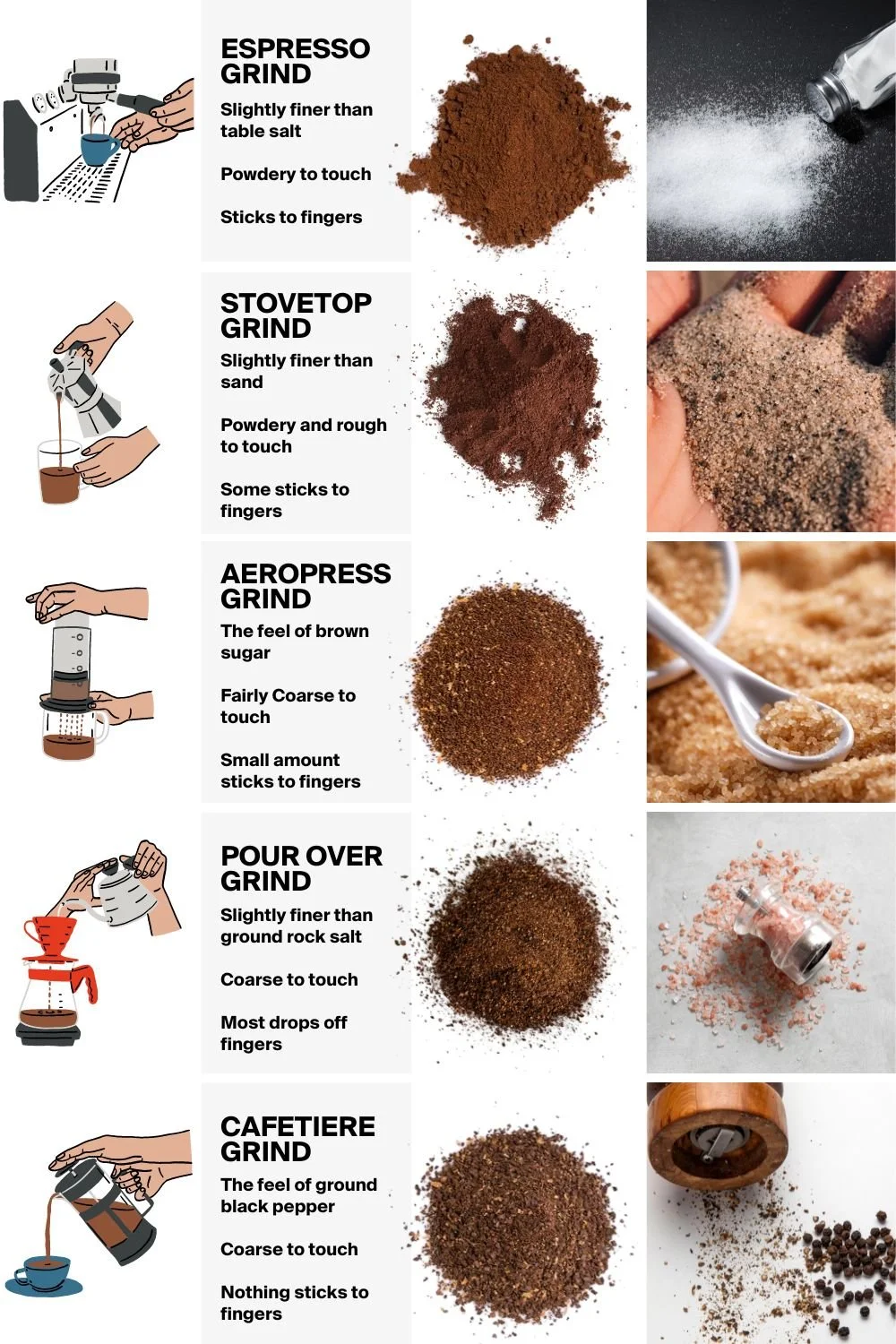
Ground espresso coffee should feel fine and even. It should not contain many large pieces. It should also not look like dust.
A useful comparison is fine sand. However, touch is not a precise test. Two grinds can feel similar but behave very differently because particle size distribution also matters. Your shot’s flow and taste are better guides than texture alone.
Why Espresso Needs a Fine Grind
Espresso water moves through a compact bed of coffee in seconds. A fine grind helps create resistance, so the water does not rush through the puck.
If the grind is too coarse, water finds an easy path through the coffee. The shot may run quickly and taste sour, thin, or sharp. This is called under-extraction, which means the water did not remove enough flavor from the coffee.
If the grind is too fine, water may move very slowly. The shot can taste bitter, dry, or harsh. This is often linked to over-extraction, although poor distribution and channeling can cause similar flavors.
Grind size changes more than speed. It also changes which compounds enter the cup and how evenly the coffee extracts. That is why a small grinder adjustment can change the taste quickly.
Espresso grind versus other coffee grinds
Use the table below as a broad guide. Grinder settings vary, so these descriptions are not universal.
| Brewing method | Typical grind | Why it works |
|---|---|---|
| Espresso | Fine | Builds resistance during a short brew |
| Moka pot | Fine to medium-fine | Supports pressure and a short brew |
| AeroPress | Fine to medium | Depends on recipe and steep time |
| Pour-over | Medium to medium-fine | Balances flow through a paper filter |
| Automatic drip | Medium | Allows steady flow through the filter |
| French press | Coarse | Reduces fine sediment during steeping |
| Cold brew | Coarse | Supports long steeping and easy filtering |
Do not use a French press grind for espresso. Large particles let water pass too quickly. Do not assume the finest possible setting is best, either. A setting that is too fine can clog the basket or create uneven flow.

How to Dial In Your Espresso Grind
Dialing in means adjusting the grind until the shot reaches a useful balance of time, yield, and flavor. You need a burr grinder with small adjustments, fresh beans, an espresso machine, a scale, and a timer.
1. Choose a starting recipe
Begin with the dose printed on your portafilter basket. If the basket says 18 grams, start near 18 grams.
Then choose a 1:2 ratio. For 18 grams of ground coffee, aim for about 36 grams of espresso. Weighing the coffee and liquid is more reliable than using volume because crema can make liquid measurements misleading.
2. Grind fine and prepare the puck
Grind the coffee directly into the basket or into a dosing cup. Break up clumps and spread the grounds evenly before tamping.
Tamp with level, steady pressure. The goal is a flat, compact coffee bed. Tamping harder does not fix an uneven bed. Good distribution matters more than trying to press as hard as possible.
Lock in the portafilter and start the shot at once. Coffee loses aroma after grinding, so do not let the grounds sit for a long time before brewing.
3. Record dose, yield, and time
Write down three numbers:
- Ground coffee dose
- Espresso yield
- Total brew time
For example:
18 grams in, 36 grams out, in 28 seconds
This record helps you make one clear change at a time.
4. Adjust the grind based on flow
Use the grind as your main control:
- If the shot reaches 36 grams too fast, grind finer.
- If the shot reaches 36 grams too slowly, grind coarser.
- If the time looks good but the taste is poor, check distribution, freshness, water, dose, and roast level before making a large grind change.
Make small adjustments. Espresso grinders often respond to tiny changes, especially when the grind is already fine.
5. Taste the shot
Numbers help you find consistency, but taste decides whether the shot works.
A balanced espresso often has sweetness, some acidity, body, and a clean finish. It should not taste sharply sour or strongly burnt. Your preferred flavor may fall outside common time or ratio ranges, and that is acceptable if the cup tastes good.

Espresso Grind Troubleshooting
The fastest way to fix espresso is to match the symptom with the likely cause. Change one variable at a time so you know what helped.
The espresso runs too fast
Signs:
- The shot reaches the target yield in less than about 20 to 25 seconds.
- The stream looks thin.
- The coffee tastes sour, weak, or watery.
First fix: Grind finer.
A coarse grind offers less resistance. Water then moves through the puck too quickly. If grinding finer does not help, check whether you are using too little coffee for the basket or whether the puck has cracks and gaps.
Uneven flow can also cause a fast shot. If water creates a channel through the puck, some coffee becomes over-extracted while other coffee remains under-extracted. The result may taste both bitter and sour.
The espresso runs too slowly
Signs:
- Little or no coffee comes from the portafilter.
- The shot takes much longer than your target.
- The coffee tastes bitter, dry, or heavy.
First fix: Grind coarser.
A grind that is too fine can restrict water flow. Excessive fines, a dose that is too large, or a clogged basket can create the same problem.
If the machine barely drips, stop the shot. Then check the grind, basket, and dose. Do not keep forcing water through a blocked puck.
The shot time looks right but tastes sour
A normal time does not guarantee balanced extraction. Sour flavor can come from a light roast, low water temperature, an uneven puck, or a shot that needs a different ratio.
Try these changes in order:
- Improve distribution.
- Grind slightly finer.
- Increase the yield modestly.
- Use a longer brew temperature or a recipe suited to the roast, if your machine allows it.
Light-roasted coffee often needs more extraction than dark-roasted coffee. It may respond well to a finer grind, a higher brew temperature, or a longer ratio.
The shot time looks right but tastes bitter
Bitter flavor may indicate over-extraction, but it can also come from a very dark roast or stale coffee.
Try:
- Grinding slightly coarser.
- Stopping the shot at a lower yield.
- Lowering the brew temperature if your machine allows it.
- Cleaning old coffee oils from the group head and basket.
Taste can also be affected by water quality and residue in the machine. A clean machine cannot rescue a poor grind, but a dirty machine can hide a good one.

The Variables That Change the Best Espresso Grind
The best grind setting is not fixed because coffee is not fixed. These factors can change how the puck resists water.
Coffee freshness
Freshly roasted coffee releases carbon dioxide. Very fresh beans can produce unstable shots and excess crema. Many coffees become easier to dial in after a short rest, but the ideal rest period varies by roast and processing method.
Old coffee often runs faster and tastes flat. Grinding finer may slow it down, but it cannot restore lost aroma.
Roast level
Dark roasts are more brittle and often extract more easily. They may need a slightly coarser grind than a light roast.
Light roasts are usually denser and can be harder to extract. They may need a finer grind, higher temperature, or longer brew ratio. These are tendencies, not laws.
Grinder type
A burr grinder is usually better suited to espresso than a basic blade grinder. Burr grinders crush beans between two surfaces and allow more control. Blade grinders chop unevenly and often produce a mix of large pieces and fine dust.
A grinder must also adjust fine enough and make repeatable changes. If the setting moves during grinding, dialing in becomes difficult.
Dose and basket size
Use a dose that fits the basket. Too much coffee can press against the shower screen and restrict flow. Too little coffee can leave a shallow puck that allows fast water movement.
Changing the dose changes the puck depth and resistance. If you change the dose, expect to adjust the grind again.
Water and machine temperature
Water temperature affects extraction. A machine that is too cool may produce sharp, thin espresso. A machine that is too hot may emphasize bitter or harsh flavors.
Many home machines do not show the actual water temperature at the coffee bed. Treat the machine’s display as a guide, not a guarantee.
Humidity and static
Weather can affect grinding and dosing. High humidity may make grounds clump. Static can scatter coffee and change the amount that reaches the basket.
These changes are often small, but they matter when you are trying to repeat a precise recipe. Weighing the dose helps control them.

Common Espresso Grinding Mistakes
Using a blade grinder
A blade grinder rarely creates the even particle size needed for consistent espresso. It may produce both boulders and powder in the same dose.
If a burr grinder is not available, use the most consistent grinder you have and focus on taste. But expect less control over shot flow.
Chasing a number on the grinder
A setting marked “espresso” is only a rough guide. Grinder brands use different scales, and even two grinders of the same model can need different settings.
Use the dial number as a record for your own grinder. Do not compare it directly with a friend’s grinder.
Changing several variables at once
If you change the grind, dose, yield, temperature, and tamp at the same time, you cannot tell what caused the result.
Change one variable first. Grind size is usually the best first adjustment when the shot is too fast or too slow.
Using volume instead of weight
Crema changes the apparent volume of espresso. A 2-ounce shot does not always contain the same amount of liquid coffee.
A small digital scale gives you a more repeatable dose and yield. It is one of the most useful tools for learning espresso.
Tamping harder to fix a fast shot
Hard tamping is not a reliable substitute for the correct grind. Once the coffee bed is compact, extra force has little effect compared with grind size and puck distribution.
Keep the tamp level and repeatable. Focus on an even bed.

Key Takeaways
- Use a fine grind for espresso.
- Start near an 18-gram dose, 36-gram yield, and 25–30-second brew time.
- Grind finer when the shot runs too fast.
- Grind coarser when the shot runs too slowly.
- Taste matters more than a fixed time.
- Use a burr grinder and weigh both coffee and espresso.
- Change one variable at a time.
- Roast level, freshness, basket size, water, and temperature all affect the result.
FAQs About Espresso Grind Size
Can I use pre-ground coffee for espresso?
Yes, but the result may be less fresh and less adjustable. Pre-ground coffee loses aroma faster than whole beans, and you cannot change the grind if the shot runs too fast or too slowly.
Use coffee labeled for espresso only as a starting point. The correct grind still depends on your machine and basket.
Is espresso grind finer than drip coffee?
Yes. Espresso usually needs a finer grind than drip coffee because it brews with less water and a shorter contact time.
The exact difference depends on the brewer. Some strong AeroPress or moka pot recipes may use a grind close to espresso, but they are not identical brewing methods.
Can espresso be ground too fine?
Yes. A grind that is too fine can block the basket, slow the shot, and create a bitter or dry taste. It can also make channeling more likely if water cannot pass evenly through the puck.
If the espresso barely flows, stop the shot and grind coarser.
Should espresso beans be oily?
Oil on the surface does not prove that beans are fresh or better. Very dark, oily beans can taste smoky and may leave more residue in the grinder and machine.
Choose beans based on the flavor you want and their roast date. A medium or light roast may offer more fruit, floral, or caramel notes, while a dark roast often gives stronger roast and chocolate flavors.
What is the best grind setting for a beginner?
Start with the fine range marked for espresso on your burr grinder. Then pull a shot and adjust based on time and taste.
There is no universal best dial number. The useful setting is the one that produces an even flow and a pleasant cup with your coffee and equipment.
Conclusion
The right coffee grind for espresso is fine, even, and adjustable. Start with a fine setting, an appropriate basket dose, and a 1:2 brew ratio. Then use shot time and taste to guide small changes.
If the shot runs fast, grind finer. If it runs slowly, grind coarser. Keep your dose, yield, and preparation consistent, and espresso dialing in becomes a simple process rather than guesswork.
Your next step is to weigh one shot, record the result, and change only the grind for the next attempt.