
For most coffee drinkers in the United States, both conical and flat burr grinders can make excellent coffee. The better choice depends on your brew method, taste goals, budget, noise needs, and willingness to manage retention and cleaning.
Conical burr grinders often suit home users who want a compact, quiet, and forgiving grinder. Flat burr grinders can offer a more uniform grind and a clean, clear flavor profile, especially for espresso and light-roast coffee. However, burr shape alone does not decide quality. Burr design, alignment, motor control, grind adjustment, and build quality matter just as much.
Introduction
Choosing a coffee grinder can feel harder than choosing a coffee maker. Product pages often focus on burr shape, but that single detail does not tell the whole story.
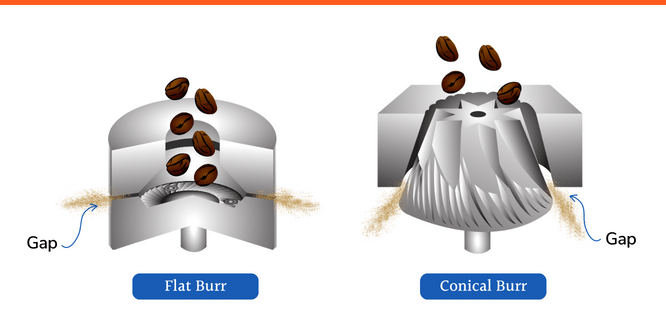
A conical burr grinder uses two cone-shaped burrs. A flat burr grinder uses two flat, ring-shaped burrs. Both crush coffee beans into smaller pieces, but they do so with different burr layouts and particle paths.
This guide compares conical vs. flat burr grinders in practical terms. It covers flavor, espresso, drip coffee, noise, heat, retention, cleaning, price, and long-term use in a typical U.S. home coffee setup.
What Is the Difference Between Conical and Flat Burr Grinders?
The main difference is the shape and arrangement of the burrs. That shape affects how beans move through the grinder, how much space the grinder needs, and how it manages heat and coffee retention.
How a conical burr grinder works
A conical burr grinder has:
- One cone-shaped burr that usually turns
- One larger ring-shaped burr that stays in place
- An opening that becomes smaller as beans move down
- A vertical grinding path
Beans enter near the top of the burrs. Gravity helps move them through the cutting area. The burrs break the beans into smaller pieces until the particles reach the selected size.
Many home grinders use conical burrs because the design can work well with a smaller motor. It also fits neatly into a compact body.
How a flat burr grinder works
A flat burr grinder has two flat, round burrs that face each other. One burr turns while the other remains fixed.
Beans enter near the center of the burrs. The spinning burr pushes them outward through a narrowing gap. The distance between the burrs controls the grind size.
Flat burr grinders often require more horizontal space. Some models also use larger motors, although motor size varies widely by product.
Simple comparison
| Feature | Conical burr grinder | Flat burr grinder |
|---|---|---|
| Burr shape | Cone and ring | Two flat rings |
| Typical body shape | Tall and narrow | Wider and more compact in height |
| Coffee path | Usually vertical | Usually from center to outer edge |
| Common strength | Compact, quiet workflow | Uniform grinding and clear flavor |
| Common use | Home brewing and espresso | Espresso, filter, and high-volume use |
| Heat behavior | Often easy to manage at home scale | Depends greatly on motor and duty cycle |
| Retention | Varies by design | Varies by design |
| Best buying clue | Burr quality and adjustment | Burr quality and alignment |
These are broad patterns, not rules. A well-made conical grinder can outperform a poorly aligned flat grinder. Likewise, a good flat burr grinder may produce a better result for one coffee but not another.

Do Conical or Flat Burr Grinders Make Better Coffee?
Neither burr shape is always better. The grinder that creates the particle distribution your brew method needs will make the better cup for you.
Particle distribution describes the range of coffee particle sizes after grinding. A batch may contain:
- Boulders, or larger particles
- Target particles, near the selected grind size
- Fines, or very small particles
The size and spread of these particles affect extraction. Large particles may extract slowly. Fines may extract quickly and can add bitterness or harshness if the brew is pushed too far.
Research from the Specialty Coffee Association and published coffee-grinding studies, such as research in Applied Sciences, show that grind size and particle distribution affect extraction and beverage quality. These sources do not prove that one burr shape always tastes better. They support a more careful conclusion: grinder design affects the particles, and the particles affect brewing.
Flavor differences
A flat burr grinder is often associated with a cleaner and more separated flavor profile. This can help when you want to taste distinct notes in a light-roast coffee.
A conical burr grinder may produce a slightly broader flavor balance. Some coffee drinkers describe this as a fuller or rounder cup. These descriptions are not universal, because roast level, burr geometry, alignment, speed, and brewing method also shape the result.
The practical difference may be small with dark-roast coffee, milk drinks, or automatic brewing. It may be easier to notice with lightly roasted coffee, espresso, or side-by-side tasting.
Consistency matters more than shape
A grinder’s real performance depends on several linked factors:
- Burr geometry — the cutting pattern and tooth design.
- Burr size — larger burrs may grind more coffee per turn.
- Burr alignment — the burrs must remain parallel and centered.
- Motor speed — speed affects feed rate, heat, and particle production.
- Adjustment range — the grinder must offer useful steps for your brew method.
- Burr condition — worn or damaged burrs can reduce consistency.
- Bean condition — very light, oily, or brittle beans behave differently.
This is why a simple “conical versus flat” answer can mislead shoppers. Burr shape is a useful category, but it is not a quality score.

Which Burr Type Is Better for Espresso?
For espresso, choose the grinder that offers fine adjustment, low retention, stable output, and enough consistency for your machine. Either burr type can meet those needs.
Conical burrs for espresso
Conical burr grinders are common in home espresso setups. They can work well when you want:
- A smaller footprint
- A quieter grinder
- Lower power use
- A simple workflow
- Espresso and other brew methods from one grinder
Many conical grinders are also forgiving when you change beans. That can help new espresso users who are still learning how grind size changes flow.
The limitation is that some entry-level conical grinders have large adjustment steps. A small change in grind size can make it hard to fine-tune espresso.
Flat burrs for espresso
Flat burr grinders can be a strong choice when you want:
- Very small grind adjustments
- Repeatable espresso dosing
- A clear, bright flavor profile
- Frequent espresso preparation
- Faster grinding for several drinks
Many commercial espresso grinders use flat burrs, but that does not mean every flat grinder is better for home espresso. A poorly designed model may retain coffee, create excess heat, or make single dosing difficult.
What to check before buying an espresso grinder
Look for these specifications and design features:
- Stepless or very fine grind adjustment
- A stable adjustment mechanism
- A usable espresso range
- Low retention or an easy purge routine
- Easy access for burr cleaning
- A portafilter holder, if you prefer hands-free dosing
- Replacement burr availability
- A motor rated for your expected workload
A grinder with a broad filter-coffee range but poor fine control may frustrate an espresso user. A highly precise espresso grinder may be less convenient for someone who switches between espresso and French press.

Which Burr Type Is Better for Drip Coffee and Pour-Over?
For drip coffee and pour-over, both types work well. Flat burrs may appeal to drinkers who value clarity, while conical burrs often offer a practical and forgiving daily workflow.
Pour-over coffee can reveal differences in grind distribution because the water moves through a bed of loose grounds. Too many fines can slow the flow and increase bitterness. Too many large particles can produce a weak or sour cup.
Still, the burr type is only one part of the process. Water temperature, pouring speed, filter shape, coffee freshness, and grind size can have a larger effect.
Choose a conical grinder for filter coffee if you value:
- A compact grinder
- Lower noise
- Simple daily use
- Occasional switching between brew methods
- A lower purchase price
Choose a flat grinder for filter coffee if you value:
- A clean and bright cup
- High repeatability
- Frequent pour-over brewing
- Precise grind adjustment
- A more specialized setup
If your current coffee tastes uneven, do not assume that replacing the burr shape will solve the problem. First check the dose, grind setting, water, brew time, and bean freshness.

Conical vs. Flat Burr Grinders: Noise, Heat, and Retention
Noise, heat, and retention depend more on the complete grinder design than on burr shape alone.
Noise
Conical grinders often run at lower speed and may sound softer. Flat grinders can be louder when they use a faster motor or larger burr set.
Sound also depends on:
- Motor design
- Gear drive
- Body materials
- Bean feed rate
- Burr speed
- The surface under the grinder
A grinder’s published noise claim may use different testing conditions from another brand. Treat direct decibel comparisons with caution unless the test method is the same.
Heat
Grinding creates friction and motor heat. Heat can rise during long grinding sessions, especially when the grinder has a small motor working near its limit.
For one or two doses at home, heat is usually less concerning than grind consistency and workflow. Heat becomes more relevant when you grind many doses in a row or use a grinder with poor ventilation.
Do not pour water into a grinder to cool it. Turn it off, unplug it before cleaning, and follow the manufacturer’s instructions.
Retention
Retention is coffee that remains inside the grinder after grinding. It can affect the next dose, especially when you change beans or brew methods.
Retention depends on:
- The shape of the burr chamber
- The exit chute
- Static electricity
- The grinder’s angle
- Humidity
- Bean oil
- The use of a bellows or other clearing method
A flat grinder can have low retention, and a conical grinder can have low retention. The opposite can also be true. Check independent measurements only when the test method and grinder version are clear.
For a single-dose workflow, look for a short coffee path, accessible burrs, a removable hopper, and a safe way to clear the chute.

Which Grinder Should You Buy?
Use your brew method and workflow as the starting point. Do not begin with burr shape alone.
| Your priority | More likely to fit | Why |
|---|---|---|
| Small kitchen | Conical burr | Many models use a tall, narrow body |
| Quiet morning use | Conical burr | Some use slower motors, though designs vary |
| Light-roast pour-over | Flat burr | May offer clarity and tight adjustment |
| Frequent espresso | Either type | Fine adjustment and alignment matter most |
| One grinder for many methods | Either type | Look for a broad, usable adjustment range |
| Several doses each day | Flat or large conical | Motor and cooling design matter most |
| Lowest upfront cost | Entry-level conical | More budget models are available |
| Single dosing | Either type | Judge retention and chute design |
| Easy cleaning | Either type | Choose a model with tool-free burr access |
Choose a conical burr grinder when:
- You mainly make drip coffee, French press, or espresso.
- You want a compact and quiet setup.
- You make one or two doses at a time.
- You prefer a forgiving grinder with a simple workflow.
- You want to spend less without giving up burr grinding.
Choose a flat burr grinder when:
- You focus on espresso or pour-over.
- You want clear flavor separation.
- You need precise grind changes.
- You prepare several drinks in a row.
- You are comfortable with a larger or more specialized machine.
A practical buying rule
If you are unsure, buy the better-built grinder rather than the more fashionable burr shape. A reliable adjustment system, strong alignment, low retention, and available replacement parts will usually matter more over time.

How to Maintain Either Burr Grinder
Regular cleaning helps preserve taste and prevents old coffee from contaminating fresh beans. It does not make an inexpensive grinder perform like a premium model, but it can keep the grinder working as designed.
Basic cleaning steps
- Turn off and unplug the grinder.
- Remove the hopper and any remaining beans.
- Follow the manual to remove the upper burr.
- Brush loose grounds from the burrs and chamber.
- Clean the chute with a grinder brush or an approved tool.
- Reassemble the grinder carefully.
- Grind a small amount of coffee and discard it if old grounds remain.
Avoid water near the motor, switches, or electrical parts. Do not use rice unless the manufacturer specifically allows it. Hard pieces can damage burrs or place stress on the motor.
Signs that the grinder needs attention
- The grind looks less even than before.
- The grinder produces unusual squealing or scraping.
- The dose changes without a setting change.
- Coffee builds up around the chute.
- Espresso flow changes sharply from one dose to the next.
- The motor slows or stops under a normal load.
Some changes come from new beans rather than a grinder fault. Light-roast beans can need a different setting from dark-roast beans, even at the same brew method.

Common Mistakes When Comparing Burr Grinders
Mistake 1: Assuming flat burrs always taste cleaner
Flat burrs may produce a flavor profile that many people describe as clean or separated. That result depends on burr geometry, alignment, speed, and coffee. Burr shape alone cannot guarantee it.
Mistake 2: Treating conical burrs as a low-quality option
Many conical grinders provide excellent coffee for home use. Some are especially practical for espresso and mixed brewing. The design is not automatically inferior.
Mistake 3: Comparing burr size without context
A larger burr may grind faster, but it does not automatically create a better cup. Motor power, alignment, burr geometry, and cooling all affect performance.
Mistake 4: Ignoring adjustment design
A grinder with many advertised settings may still have large gaps in the range you need. For espresso, look for fine control. For French press, make sure the grinder can produce a coarse setting without excessive fines.
Mistake 5: Changing too many variables at once
When dialing in coffee, change one main factor at a time. If you change the grinder, beans, dose, water, and recipe together, you will not know what caused the result.

Frequently Asked Questions
Are conical burr grinders better for home use?
They can be a good fit for home use because many are compact, quiet, and easy to operate. However, a flat burr grinder may suit you better if you focus on precise espresso or light-roast pour-over coffee.
Are flat burr grinders better for espresso?
Not always. Flat burr grinders often provide precise adjustment and can produce a clear flavor profile, but a well-aligned conical grinder can also make excellent espresso. Adjustment quality and burr alignment matter more than shape alone.
Do conical burr grinders create more fines?
The answer depends on the specific burr set and grind setting. Different burr designs create different particle distributions. It is not accurate to say that every conical grinder creates more fines than every flat grinder.
Which type lasts longer?
Lifespan depends on motor quality, burr material, workload, cleaning, and replacement-part support. A grinder that is used within its rated capacity and maintained well may last longer than a more expensive grinder that is overloaded.
Can one grinder handle espresso and drip coffee?
Yes, many grinders can handle both. Look for a wide adjustment range, stable settings, low retention, and a design that makes switching easy. Some grinders are optimized for one method and may be frustrating for the other.
Final Recommendation
For most U.S. home brewers, choose a conical burr grinder if you want a compact, quiet, flexible, and simple setup. Choose a flat burr grinder if you prioritize precise control, flavor separation, or a more dedicated espresso and pour-over workflow.
The best choice is not decided by burr shape alone. Compare the full grinder: burr geometry, alignment, adjustment system, motor, retention, cleaning access, noise, warranty, and replacement parts.
Start with your main brew method. Then choose the grinder that makes that method easy to repeat every morning.