French press cold brew is cold coffee made by steeping coarse coffee grounds in cool water, then pressing and filtering the grounds. For a simple U.S. home method, combine 1 cup of coarse coffee grounds with 4 cups of filtered water, steep for 12 to 16 hours in the refrigerator, and press slowly before serving over ice.
This method makes smooth, low-acid-tasting coffee without a special cold brew machine. It works well in a standard 32-ounce French press and lets you make several servings at once.

What Is French Press Cold Brew?
French press cold brew uses immersion brewing. The coffee grounds sit in water for many hours instead of being exposed to hot water for a few minutes.
A French press is useful because its plunger separates most of the grounds from the brewed coffee. It does not remove every fine particle, though. You may still see a small amount of sediment in the cup.
Cold brew is not the same as iced coffee. Iced coffee is usually brewed hot and then cooled over ice. French press cold brew is extracted with cool or room-temperature water from the start.
The result is often:
- Smooth and mellow
- Less sharp-tasting than many hot coffees
- Full-bodied
- Easy to dilute or sweeten
- Convenient to prepare ahead
Cold brew does not always contain less caffeine than hot coffee. Caffeine depends on the coffee dose, water ratio, steep time, bean type, and serving size.

What You Need
You need only a few basic items to make French press cold brew.
Equipment
- A French press
- A kitchen scale, if available
- A burr grinder or coarse pre-ground coffee
- A measuring cup
- A spoon
- A storage jar or sealed bottle
- Ice and a glass for serving
A 32-ounce French press is a practical size for a small batch. Leave space below the top so the plunger can move without spilling.
Ingredients
- Coarsely ground coffee
- Filtered water
- Ice, milk, or sweetener for serving
Use coffee ground about as coarse as coarse sea salt. Fine grounds can make the drink muddy, bitter, and hard to press.
Filtered water often gives clearer flavor than strongly chlorinated tap water. Use cold or room-temperature water. Very hot water is not needed for this recipe.

French Press Cold Brew Ratio
The best starting ratio is 1 part coffee to 4 parts water by weight for a strong concentrate. You can dilute it with water or milk after brewing.
| Batch size | Coffee | Water | Approximate servings |
|---|---|---|---|
| Small | ½ cup, about 45 g | 2 cups, 475 g | 2 to 3 |
| Standard | 1 cup, about 90 g | 4 cups, 950 g | 4 to 6 |
| Large | 1½ cups, about 135 g | 6 cups, 1,425 g | 6 to 9 |
These amounts are starting points, not fixed rules. Coffee grounds vary in density, so weight gives a more reliable result than volume.
For ready-to-drink cold brew, try 1 part coffee to 8 parts water by weight. This makes a lighter batch that may not need much dilution.
How to Adjust the strength
if your cold brew tastes too strong, add water or milk to the glass. This is usually better than changing the whole batch after brewing.
If the next batch tastes weak, use more coffee or less water. You can also steep for a little longer, but time is not a complete substitute for enough coffee.
A useful serving starting point is:
- ½ cup cold brew concentrate
- ½ cup water or milk
- Ice to fill the glass

How to Make French Press Cold Brew
Follow these steps for a clean, balanced batch.
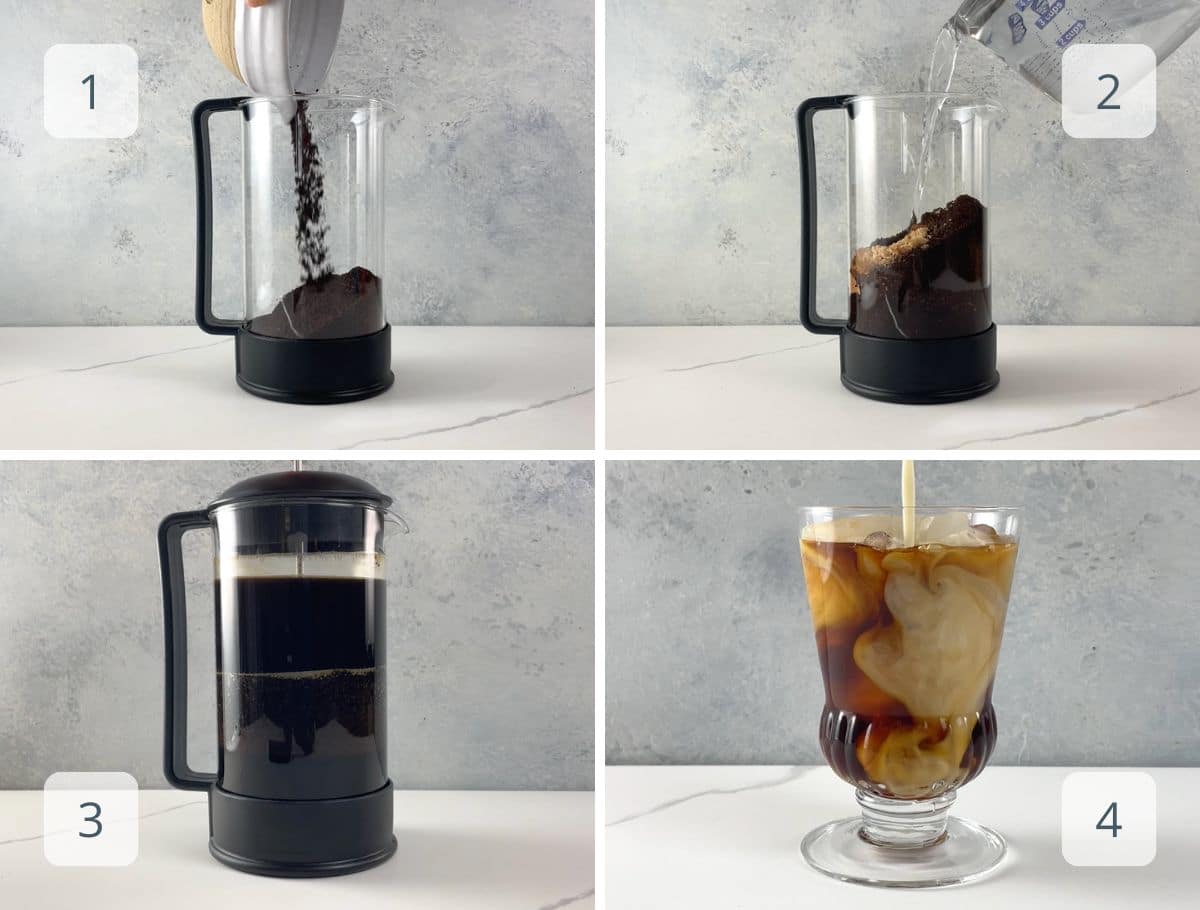
1. Grind the coffee coarsely
Grind fresh coffee just before brewing if possible. Choose a coarse setting similar to French press coffee, but slightly coarser if your grinder allows it.
Avoid fine espresso grounds. They can pass through the filter, create heavy sediment, and make pressing difficult.
2. Add coffee to the French press
Place the dry grounds in the bottom of the French press. Check that the press is clean and free of old coffee oils.
For a standard batch, use about 90 grams of coffee with 950 grams of water.
3. Add the water
Pour the water over the grounds in a slow, steady stream. Make sure all the grounds become wet.
Use a spoon to stir gently. Do not whip or aggressively churn the coffee. A gentle stir helps prevent dry pockets without adding much sediment.
4. Steep for 12 to 16 hours
Place the French press in the refrigerator while it steeps. Cover it with the lid, but keep the plunger raised.
Start with 14 hours if you are unsure which time to use.
- 12 hours: lighter and often brighter
- 14 hours: balanced starting point
- 16 hours: stronger and fuller
- More than 18 hours: may taste woody, harsh, or overly heavy
Steeping time is affected by grind size, coffee dose, water temperature, and personal taste.
5. Press slowly
When the coffee is ready, press the plunger down with steady, gentle pressure. Do not force it.
If the plunger feels stuck, lift it slightly and press again. Excess force can push grounds around the filter or damage the glass beaker.
6. Strain again if needed
Pour the cold brew through a paper coffee filter or fine-mesh strainer if you want less sediment.
This second filter can slow the process, especially if the coffee contains many fine particles. Pour gently and do not squeeze the grounds.
7. Dilute and serve
Pour the cold brew over ice. Add water, milk, cream, or a sweetener to taste.
For a strong concentrate, begin with equal parts cold brew and water. Adjust from there.

How to Make Cold Brew Taste Better
The most important variables are coffee freshness, grind size, water quality, ratio, and steep time.
Choose the right coffee
Medium and medium-dark roasts often work well because they provide chocolate, nut, caramel, and spice notes. Light roasts can also make good cold brew, but they may taste more tart or tea-like.
Use coffee that you already enjoy hot. Cold brewing will not hide stale beans or poor storage.
Whole beans usually keep their aroma longer than pre-ground coffee. Store them in an airtight container away from heat, light, and moisture.
Use a consistent grind
An inconsistent grinder can produce both large chunks and fine dust. The large pieces may under-extract while the fine pieces add bitterness and sediment.
A burr grinder usually gives a more even grind than a basic blade grinder. If you use pre-ground coffee, choose coffee labeled for French press or coarse brewing.
Control the steep time
A longer steep does not always make better cold brew. It can increase strength, but it may also add harsh or woody flavors.
Change one variable at a time. If the coffee is bitter, shorten the steep or use a coarser grind. If it is weak and sour-tasting, use more coffee or steep slightly longer.
Do not judge it before dilution
Cold brew concentrate can taste intense when sampled on its own. Dilute a small amount before deciding whether the recipe needs changes.
This prevents you from weakening the entire batch based on an undiluted taste.

French Press Cold Brew Troubleshooting
Small changes can fix most cold brew problems.
| Problem | Likely cause | Try this next time |
|---|---|---|
| Bitter or harsh | Too fine a grind, too much coffee, or too much time | Grind coarser or steep for less time |
| Weak or watery | Too little coffee, too much water, or too little time | Increase the coffee dose |
| Sour or sharp | Under-extraction or a light roast profile | Steep longer or use a different coffee |
| Muddy texture | Fine grounds or an uneven grind | Use coarser coffee and filter twice |
| Very slow pressing | Too many fine grounds | Use a coarser grind |
| Flat flavor | Stale coffee or poor water | Use fresher coffee and clean-tasting water |
| Bitter taste after several days | Oxidation or poor storage | Keep it sealed and refrigerated |
If the coffee is too bitter
Do not add more steeping time. First dilute the batch to see whether the strength is the main issue.
For the next batch, use a coarser grind and reduce the steep time by two hours. A darker roast may also taste more bitter because it can produce strong roasted flavors.
If the coffee is too weak
Add a little concentrate if you have some saved. Otherwise, dilute less when serving.
For the next batch, keep the same steep time but increase the coffee dose by 10% to 15%. This makes it easier to see whether the ratio was the problem.
If the coffee is gritty
Pressing alone may not remove fine particles. Pour the coffee through a paper filter after pressing.
Do not press harder to force the coffee through. This can push more fine sediment into the drink.

How to Store French Press Cold Brew Safely
Transfer finished cold brew to a clean, covered container and refrigerate it promptly. Keeping the coffee cold slows quality loss and limits exposure to air.
For best flavor, drink it within a few days. The U.S. Department of Agriculture gives a general three- to four-day guideline for many refrigerated leftovers, but cold brew quality may change before that point.
Discard the batch if it develops:
- A moldy appearance
- A sour or fermented smell
- An unusual slimy texture
- A flavor that seems clearly spoiled
Do not rely only on taste to judge safety. When in doubt, throw it out.
Keep milk, cream, and sweeteners separate until serving. Dairy can shorten the usable life of the drink and can make the storage container harder to clean.
Wash the French press after each batch. Coffee oils and fine grounds can collect around the filter screen and affect the next brew.
French Press Cold Brew vs. Other Cold Coffee Methods
French press cold brew is convenient, but it is not the only option.
| Method | Main feature | Best for |
|---|---|---|
| French press | Simple immersion and built-in plunger | Small home batches |
| Mason jar and strainer | Low-cost setup | Occasional cold brew |
| Dedicated cold brew maker | Easier filtering and storage | Frequent batches |
| Pour-over iced coffee | Hot coffee brewed over ice | Fast preparation |
| Cold drip brewer | Slow dripping water through grounds | More controlled brewing |
The French press offers a useful balance of cost and convenience. It is easier than building a separate filter setup, but it may leave more sediment than a dedicated brewer with a fine paper filter.
Choose iced coffee instead when you want a drink within minutes. Choose cold brew when you want to prepare coffee ahead.

Is French Press Cold Brew Less Acidic?
French press cold brew often tastes less acidic or less bitter than hot coffee, but that does not mean it is acid-free.
Flavor perception depends on the coffee, roast, water, grind, ratio, and brewing temperature. Some research has found that cold brew and hot coffee can have similar pH values even when people describe them differently.
If hot coffee bothers your stomach, cold brew may feel better to you, but it is not a guaranteed solution. Caffeine can also affect some people. Consider a smaller serving or a lower-caffeine coffee if needed.
People with medical concerns about coffee, caffeine, reflux, or stomach symptoms should follow advice from a qualified health professional.

Key Takeaways
- Use coarse coffee grounds and filtered water.
- Start with a 1:4 coffee-to-water ratio for concentrate.
- Steep in the refrigerator for 12 to 16 hours.
- Press slowly to reduce sediment.
- Dilute before serving over ice.
- Store cold brew in a sealed container in the refrigerator.
- Use a paper filter if you want a cleaner cup.
- Change one variable at a time when adjusting the recipe.
FAQs
Can I make French press cold brew at room temperature?
Yes, but refrigerator steeping is easier to control for storage and serving. If you steep at room temperature, transfer the coffee to the refrigerator as soon as brewing ends and keep it covered.
Can I use regular ground coffee for cold brew?
You can, but coarse grounds work better. Fine grounds may create a muddy drink, clog the filter, and make the plunger difficult to press.
How long should cold brew steep in a French press?
Start with 14 hours in the refrigerator. Use 12 hours for a lighter result and up to 16 hours for a stronger batch. Adjust based on taste.
Should I press the French press before refrigerating it?
No. Keep the plunger raised while the coffee steeps. Press after the steeping period is complete.
Can I drink French press cold brew without diluting it?
Yes, if you made a ready-to-drink ratio. A 1:4 batch is usually a concentrate, so dilute it with water or milk before serving.
Conclusion
French press cold brew is a simple way to make smooth iced coffee with equipment many people already own. Use coarse grounds, a measured ratio, a 12- to 16-hour refrigerator steep, and slow pressing for the most reliable results.
Start with 90 grams of coffee and 950 grams of water. Dilute a small serving first, then adjust the next batch by changing only one factor: the ratio, grind, or steep time.